I Hate The Waltons

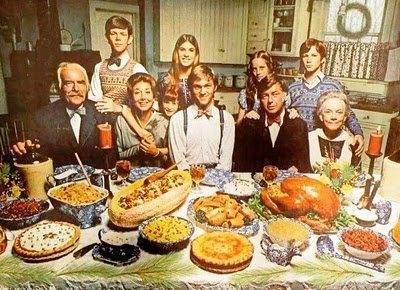
The whole contemptible Walton clan struggling through hard times with another meager meal.

I hate the Waltons.  Not the Walmart Waltons.   I like them.  Save money.  Shop smart.  Only at Walmart. That’s good stuff. I mean the TV Waltons–John, Olivia, John Boy, Jason, Mary Ellen, Jim Bob, Ben, Erin, Elizabeth, Grandpa and Grandma.  All of them.

In real life, I try not to hate people.  It’s just not good.  I have no such reservations with fictional characters.  Aunt Bee, Jenny from Forest Gump, Bruce Dern in The Cowboys, any Jim Carrey character–each of these is vile in its own way and intended to be so.  The Waltons, though, are different. They are supposed to be sympathetic, even likeable, yet I hate them.  Why?

The Depression

The Waltons lived in the Great Depression, except for them it was the Not So Bad Depression.  They had a house.  A sawmill.  A truck. They lived on Walton’s Mountain, which means they had their own freakin’ mountain, for God’s sake.  Ever see their meals? Roast pig, turkey, chicken, vegetables, pies, cakes–you name it.  My Dad grew up in the Great Depression in a house with seven kids.  Mush, that’s what they ate.  Oh, and maybe ham they cured themselves.  The Waltons lived like kings.  I hate that.

Here’s what a family with seven kids looked like during the Depression.

The Parents

John and Olivia were a lovey-dovey pair right up until Olivia got shipped off to a TB sanitarium in a contract dispute. So solemn, so wise, just like real parents, right?  Here’s how you’d be if you had seven kids with all the drama of that crowd:  John Boy would come in with one of his pressing social issues he was trying to resolve.  John would look at him and say:  “How the hell should I know?”  Or he’d say something like:  “Hey, egghead, how ’bout working at the damn sawmill for a while?”

The Kids

Okay, I know there were seven of them, but there really were only three and a half for all practical purposes.  John Boy, Mary Ellen and Jason. These were the Big Three before anyone ever heard of Kevin Garnett, Ray Allen and Paul Pierce.   The other four just drifted in and out occasionally.  I’m not even sure Erin was really on the show.  She disappeared for long stretches.  I never could keep Jim Bob and Ben straight.  I had to remind myself that Jim Bob delivered his lines like he’d suffered a debilitating head injury.

One would think that the casting folks could have at least tried to find kids who resembled each other to play siblings.  In a modern setting, that bunch would have subject to DNA testing the first time anyone saw them together.

John Boy is my biggest problem.  He’s like one of those people you should like, but you just can’t.  You know the type.  The neighbor who is very friendly, always speaks and will help you with anything.  You want to kick a nail into his ear.  John Boy is like that.  Almost every episode has “Here he goes, again” moment with John Boy.  He’s helping someone or misunderstood or stuck in the middle of some issue.  Lighten up, John Boy.

Earl Hamner wrote The Waltons, and I assume John Boy–being a writer–is modeled after him.  That probably explains why he dominates the Walton landscape.  Here’s a question:   Was Hamner called Earl Boy?  If not, why the hell is John called John Boy?  NO ONE HAS EVER BEEN CALLED THAT!  If you grew up in the ’70’s and shared this name, you were at some point called “John Boy.”  Even today, you will be called that.  I know from whence I speak on this one.  That is reason enough to hate John Boy.

I have to mention Fake John Boy.  At some point in the series, Richard Thomas (John Boy) decided to leave to pursue other acting opportunities in the most ill-conceived career move since Pernell Roberts abandoned the Ponderosa to embark on his storied movie career.  Fake John Boy was worse than the real one.  He wasn’t John Boy.  Oh, he was nauseatingly earnest like the real one, but you couldn’t help but yell “FAKE!” when he was on the screen.  Okay, maybe I’m the only one who did that.

GRANDMA AND GRANDPA

Look, I know generations of families used to live to together.  I guess that was realistic enough.  Man, these two had their noses in everything.  I hated them.

Wil Geer played Grandpa.  He was a hippie and friend of Woody Guthrie, which means I should have liked him, but no, I didn’t.  I think it’s because the writers couldn’t figure him out.  Was he comic relief?  Was he a wise old sage?  Was he just a pain in the ass like some old people?  You never knew for sure.  To some extent, he suffered from a 1970’s phenomenon known as “The Hip Oldster.”  In the ’70’s, TV writers, being largely devoid of original ideas, wrote every older character the same.  They would be hip, oversexed, “cool” people.  They rode motorcycles and said naughty things.  Sometimes, that’s what they did with Grandpa.  Sometimes, he was the voice of reason.  Mostly, he just annoyed me.

Ellen Corby was a little more tolerable as Grandma.  She actually acted liked an old lady.  Surly, hard to deal with, opinionated and not particularly pleasant.  Now that I think about it, I kinda of like her.

The Godseys

Ike Godsey owned the General Store.  Other than a few passing references to “hard times,”  Ike seems to have thrived through the Great Depression and the rationing of World War II.  His store was FULL of stuff.  He was probably the richest man in Virginia by the end of the war.
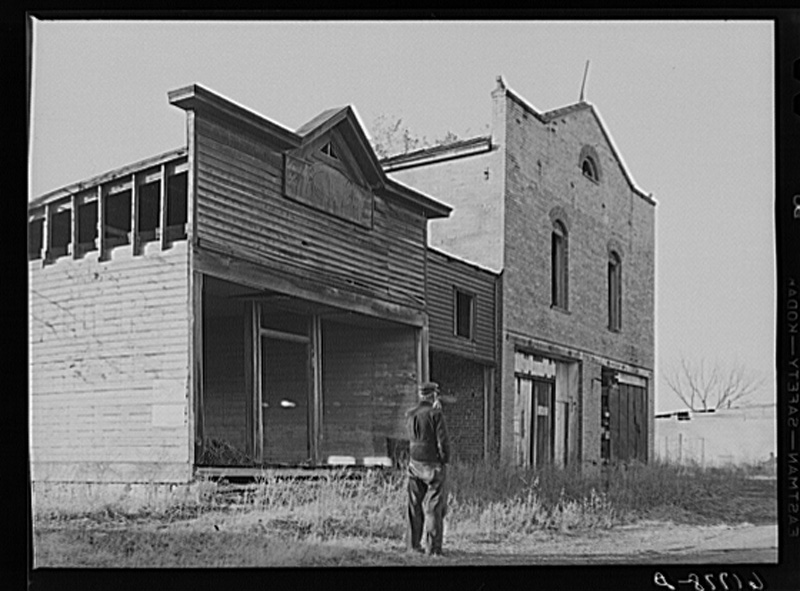
Cora Beth wouldn’t have been so fired up about “Mr. Godsey” if he’d owned this Depression era store.

He married Cora Beth, an impossibly haughty friend or distant relative of Olivia’s who showed up to sponge off the Waltons’ inexplicable largesse.  Ike decided to marry her.  Even John recognized what a pain in the ass Cora Beth was and tried to talk Ike out of marrying her.  Like a lot of folks, he didn’t listen and married her anyway.  She continued to preen around for years.  Oh, and she always called Ike “Mr. Godsey.”  I hated that.

How about have Erin turn up pregnant and marry Ike in a shotgun wedding?  That would have been a ratings bonanza!  Plus, Erin would have actually played role in the show.  No, we got Cora Beth.  I hated her.

The Pathos

At the heart of The Waltons was some pitiable, sad story with a comparatively uplifting ending, usually because of the superior intelligence or morality of the Waltons themselves.   No family is THAT good, except maybe the Cartwrights.  I cared nothing for it and always wanted the Waltons to get put in their place.  It never happened.  I hated that.

The Ending

Good night, John Boy.  Good night, Mary Ellen.  Good night, Jim Bob.  Blah, blah, blah.  That’s how the show always ended.  Hey, were they all in the same freakin’ room?  That’s weird, especially since they were able to say good night to their grandparents without raising their voices.  I shared a room with two brothers when I was little.  It’s not fun.  Just once–once, mind you–I wanted someone to say:  “Hey, shut the hell up!  I’m trying to sleep!”  No one ever did.  I hated that.
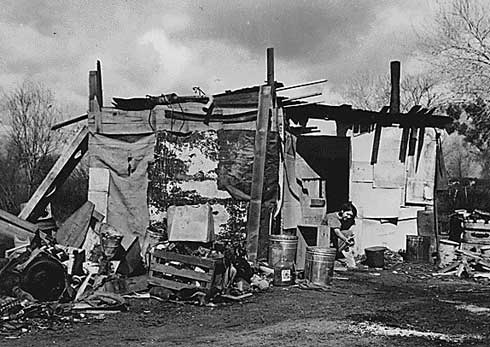
Here’s the kind of house the Waltons would have lived in. I’m guessing they wouldn’t have been quite so chipper at bedtime in this place.

At this point, you’re asking:  “If you hate the Waltons, why do you know so much about them?”  First, that’s really none of your business.  Second, I watched a lot of TV as a kid.  A lot.  I didn’t care what I watched.  I watched the Waltons to just hate them.  Sometimes, my Dad would watch with me and ridicule them.  I liked that.

Occasionally, I’ll see the Waltons on TV and tune in for a few minutes.  It doesn’t take long for me to be disgusted.  I always hope I’ll catch the episode when their house burned.  At least I think that happened.  Maybe that was just my own fantasy.

Good night, John Boy.

©thetrivialtroll.wordpress.com 2012

Love and the Color TV

Your author pictured in the middle being forced to watch black and white TV. I can’t even look directly at it. December 1962.

“This is the happiest day of my life.”  Thus I spoke one day in 1967.  I was 4 years old and talking to a television salesman.  Why was I so happy?  My family had just purchased its first color television.  Color TV, my friends.  It was that simple.  I had seen Batman and Get Smart with their tantalizing “In Color” graphics at the bottom.  Until that day, I could only dream of what that really meant.  Lost in Space, too was in color, as were many other TV shows.  Even at 4 years old, I knew that a life-changing event was unfolding.

My first color TV. No, it wasn’t crooked. That’s the photo–I think.

I think the TV was an RCA.  Could have been a Philco or Zenith.  Of course, it had a round screen.  No remote control, either.  The only remote control I had ever seen was on an episode of Dennis the Menace.  It was roughly the size of a brick.  No, our new TV had a dial.  That was okay, because I liked to sit so close to it that I could just reach up and turn the channels as needed.  My mother told me that sitting close to the TV would cause me to die of radiation poisoning, but I was willing to risk it.  (As a side note, she said standing beside the TV would give one a mega-dose of deadly radiation waves.  I never bothered to find out if any of that was true. After all, you couldn’t see the screen).

TVs used to be complex.  They were called TV “sets,” for some reason.  If you removed the back, the cabinet was full of vacuum tubes of every size imaginable.  Those tubes held all the magic, especially the big one–the picture tube.  I was never allowed behind the TV.  My mother made it clear that to venture to the back of the TV was almost sure to result in sudden and fatal electrocution injuries.  I did, however, have occasion to watch the TV repairman work on it.

Oh, yes, there were TV repairmen.  They would come to your house and work on the TV.  They carried large cases full of vacuum tubes.  Once, I mistook the Jewel Tea Man for Mr. Simms, the TV repairman.  I furiously castigated him for being so late to fix the TV.  I think I was 6 years old at the time.  I was serious about the TV.

TVs used to be full of these. They held all the magic.

Remember vertical and horizontal “hold” dials?  If you do, you’re as old as I am.  For the uniformed, these were tuning knobs you could use to adjust the picture if the screen image began rolling or zig zagging. “DON’T TOUCH THOSE DIALS.”  If you messed up the picture, you might never get it right again.

TV was dangerous in those days, too.  If you broke the picture tube, the TV would explode, killing everyone in the house.  “DON’T HIT THE SCREEN WITH ANYTHING.”  There was the poor boy who–for reasons that remained obscure–kissed the screen and died immediately.  My mom never said whether he was related to the boy who died under similar circumstances kissing a toaster, but it seems likely.  Perhaps my unbridled love of the TV made mom concerned that I would get carried away with passion.  At least I understood the toaster story, given that I liked to stare at my reflection in it like a small Narcissus.

TV stations used to go off the air at midnight, some at 11:30.  They’d usually sign off with The Star Spangled Banner.  You’d just have white noise or maybe a test pattern until 6:00 a.m.

Black and White Test Pattern. What this was supposed to test or why it had an Indian on it are beyond me.

I don’t know the purpose of the test pattern, but someone used it to test something every night.  The old TVs were powered by the magic of the cathode ray:

Diagram showing the basic set up of a TV picture tube.

To this day, I don’t understand any of this.  To me, here is how it works:

Your author’s basic understanding of television technology.

We all know the power of television.  Dress up any troglodyte and put him on TV enough, and–PRESTO!–he’ll be elected to public office.  Have you ever been on TV?  Doesn’t it make you feel like you’re just a little better person than you were before?  People will say:  “Hey!  I saw you on TV!”  You could be on TV eating a live squirrel and people would still think:  “Hmmm.  There’s something different about him, now.”  The first time I was on TV, I was probably 8 years old.  It was the Harlan County Poke Sallet Festival Parade.  My brother and I were riding in a convertible.  I think it was John L. Belcher’s car.  If not, it should have been.  It was the kind of car John L would have driven.

Virgil Q. Wacks filmed the parade for his TV show, Virgil Q. Wacks Variety Time.  If you’re not familiar with Virgil Q, I can’t describe his show.  It was a kind of an advertising/travelogue program.  He filmed us in the car and there we were–on TV.  His film collection is archived at East Tennessee State University where we live forever.

There were many disadvantages to growing up in Harlan County, Kentucky, but TV wasn’t one of them.  We had cable.  That’s right–cable TV in the 1960’s  It was the only way to get a TV signal in the mountains.  (As a side note, I am the owner of 1 share of Harlan Community Television, Inc., the longtime local cable company).  In those days, TV channels ranged from 2 through 13, with the little understood UHF channel to boot.  We had signals on all the channels on the dial:  Lexington, Kingsport, Knoxville,  Asheville.  We might have been Ground Zero in the War on Poverty, but by God we won the TV War before it even started.

I loved that color TV.  Eventually, the dial (or channel changer, as I called it)  fell off.  As most families did, we replaced it with a pair of pliers until it could be located, a minor inconvenience.  Sometimes, I would lie on my back and watch the TV upside down just for the hell of it.

I spent many hours in front of that TV. Yes, Batman was in color.  Spectacular color, too.  By the end of the ’60’s, everything was in color! When I was around 8, I started watching sports on that TV.  Hey, kids:  There used to be one Major League Baseball game a week on TV.  It was called, fittingly enough, The Game of the Week.  It came 0n Saturdays, and I always watched.  There was also an NBA Game of the Week.  My earliest sports memory is Wilt Chamberlain and the Lakers vs. Lew Alcindor and the Bucks.   You rarely saw some athletes at all.  The only time you’d see some players would All-Star games or playoffs.  The NFL, being ahead of its time, always had a couple of games on Sundays.

I am part of the TV Generation.  I knew the TV schedule every night of the week.  When I was 3 years old, I surprised my parents by counting to 100 one night.  When my mother asked where I learned that, I could only reply:  “From the TV.”  I was told–and still am–that TV will rot my brain.  Perhaps it has.  I know the lyrics to the theme for Gilligan’s Island, yet I will sometimes forget my children’s birth dates.

One of the calling cards of the intellectual is the refrain that “I don’t watch television.”  I’m not an intellectual, and I do watch TV.  Always have, always will.  I watch sports on TV.  I watch movies on TV.  I watch sitcoms and true crime and reality shows.  I’ll watch anything for a few minutes.  I’ll watch Toddlers & Tiaras just to get outraged.  I’ll watch shows about 900 pound people.  I’ll watch reruns of King of Queens just to marvel at how it could have been on the air for years.  It’s as funny as a truck load of dead babies, but I’ll watch it.  I’ll watch the news, the weather, the History Channel.  I’ll watch Road House for 500th time.  I may know more about the Beverly Hillbillies than any person alive, and I’m proud of it.  TV series, miniseries, short films, previews, reviews–everything.

That first color TV didn’t stay around all that long.  Within a few years, my father enjoyed some financial success, and we had TVs everywhere.  We even got a remote control Zenith.  We had a TV in our bedroom (technically, it was my brother’s).  We had a TV in the kitchen, too. The old TV was relegated to the basement where we continued to use it, but it was now like an old horse put out to pasture.  Like a horse, it sat in that basement for many years after it quit working entirely.

Now, I have monstrous TVs.  46 inch, 60 inch, plasma, LCD, high def–you name it.  Hundreds and hundreds of channels–all at my finger tips.  I not only have a remote control, I have a pillow which doubles as a universal remote. None of them, though, ever thrilled me like the first one.  I’ve loved them all, but none of them–none–ever made me declare that it was the best day of my life.

One day, there may some disaster which destroys society and forces us to start over.  The first thing I’ll do is try to figure out how to build a TV.  TVs–like ships and airplanes–work on some kind of magic, I’m sure.  So, I don’t where I’d start, but I’d get right on it.

Oh, and it would have to be a color TV.

©thetrivialtroll.wordpress.com 2012

All the World’s a Stooge

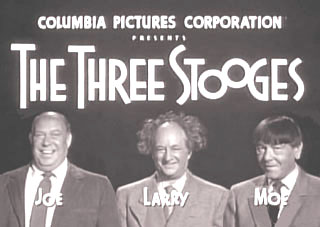
Classic Columbia Pictures Title Card

I am an unapologetic Three Stooges fan.  I have been almost my entire life.  My Dad and I watched them and laughed together.  My sons and I have done the same.  My youngest son and I recently saw the Farrelly Brothers’ new Three Stooges film and laughed ourselves into fits.

Who were the Stooges?  Moses Horwitz (Moe Howard); Louis Feinberg (Larry Fine); Jerome Horwitz (Curly Howard); Samuel Horwitz (Shemp Howard);  Joe Besser; and Curly Joe DeRita.  Moe, Curly and Shemp were brothers.  The original line-up was Moe, Larry and Shemp.  Curly replaced Shemp.  Shemp then replaced Curly.  The abominable Joe Besser replaced Shemp.  Finally, Curly Joe replaced Besser.

People have always joked about men liking the Stooges and women hating them.  Back when Jay Leno was funny (yes, kids, he WAS very funny), he said the major difference between men and women is that all men believe that The Three Stooges are “comic geniuses” and all women think they are “shitheads.” Perhaps.

Just to prove my expertise to you the reader, I have done no research for this post.  I am simply drawing from my immense knowledge of the Three Stooges gathered over the years.  Impressed?  You should be.

MR. BILL

In Harlan County, Kentucky, we had cable TV before almost everyone in the country–since the 1950’s, in fact.  Why? Because we were so isolated in the mountains that we couldn’t get decent TV reception from antennas.  Thus, someone came up with the brilliant idea of connecting our homes one huge antenna by cable connections.  This was my pipeline to the Stooges.

For you youngsters out there, televisions used to have “dials” to change channels.  The channels ran from 2 through 13.  We Harlan Countians had reception on ALL of them.  Good, clear reception, too.  One of the channels we got was WLOS out of Asheville, North Carolina.  WLOS delivered the Stooges. On weekdays, before school, most kids watched WLOS’s “Mr. Bill Show.”  Mr. Bill was Bill Norwood.  There was nothing especially entertaining about Mr. Bill.  He was just a nice guy who read kids’ letters and showed their drawings on TV.  He showed cartoons and–most importantly–Three Stooges shorts.  When Mr. Bill was on vacation, his substitute was WLOS weatherman Bob Caldwell.  Bob did the same things as Mr. Bill but seemed to me to be an utter failure.

The Shorts

What is a “short?” you ask.  Well, theaters used to show cartoons and “shorts” before the feature.  Shorts were typically 20-25 minutes long.  Our Gang (aka The Little Rascals) was a classic short.  The Stooges were Columbia Pictures’s cash cow when it came to shorts.  They made shorts from the early 1930’s through the late 1950’s.  When TV came along, the Stooges made it on the air and found a whole new audience.  By the late ’50’s, the Stooges (those left) were long in the tooth but became more popular than ever.

Stooges shorts consist of the Stooges finding themselves in some type of predicament (pretending to be chefs, buying a racehorse, in the Army, etc.).  They usually are in conflict with someone else and each other.  Moe is the leader and inflicts frequent, violent punishment on the other Stooges.  Eye pokes, hammers to the head and face slaps are but a few examples.  My personal favorite is when Moe raked a cheese grater across Curly’s face.

Most films follow a similar story arc.  This first 10 minutes or so introduce the characters.  Then, a conflict is introduced as the first plot point and turns the film toward its story.  A final plot point is introduced and turns the film toward the resolution of the conflict, or end of the film.  Here’s an example from The Godfather:

  • Introduction:  Connie’s wedding introduces all the main characters of the Corleone family.
  • Conflict:  The four other crime families want the Corleones in the drug business.  This is the first plot point.
  • Story:  Michael becomes involved in the family after his father is shot.  Kills The Turk and McCluskey.  Goes into hiding.  Eventually returns.
  • Resolution:  Final plot point is the meeting between Michael and the Godfather in the garden.  Then the film moves toward resolution of the conflict.  In that case, killing everyone.

A film scholar would debate me on some of the details, but that’s the basic set-up of every film. The Stooges had none of that.  Their films were too short.  We know the Stooges and we know what they do:  Hit each other a bunch, make fun of people and ended up okay.  We watch for the slapstick, not the story.

So, why do I love the Stooges?  Read on, my friends.

Gimme Moe, Moe, Moe!

Don’t we all secretly (or not so secretly) want to be like Moe?  Moe is the boss, the ringleader, the one everyone looks to for their decisions.  He gladly accepts this role and gives no quarter.  He doesn’t hesitate to rip out huge hunks of Larry’s hair or to poke Curly in the eyes, despite the retinal damage it will cause.  He’s sawed Curly’s head, pulled his teeth and put his head in a vise.  He’s steam pressed Curly, slapped and kicked him.  Moe had to keep them in line and he did.

Moe helping Curly with a tooth problem.

Moe was a big brother, a boss and stern taskmaster.  When all was said and done, Moe cared for his fellow Stooges.  How many times did he say:  “I’m sorry, kid”?  He meant it, even if those words were followed by a slap in the face.

In real life, Moe was a fine fellow by all accounts. Kind, generous and caring.  He looked after his brothers, especially Curly when his health failed at far too young an age.  Moe enjoyed the Stooges’s resurgence in popularity and never shied away from his Moe persona.  I like that.  He was Moe.

Moe being Moe on the Mike Douglas Show in the 1970’s.

Curly

Curly (or Curley, as it was sometimes spelled) was the Olivier of the Stooges. The Stooge by which all Stooges are measured. Whether he was barking or spinning in the floor, Curly left an indelible mark on every short in which he appeared.

Curly was a comic genius.  He was a phenomenon.  I laugh almost every time he appears on-screen.  The following is just a sampling of his greatness:

  • Woob! Woob! Woob!  Curly’s trademark yell.
  • Nyuk, nyuk, nyuk.  Curly’s laugh.
  • The floor spin.  Curly lies on his side and spins in a circle.
  • “Soitenly!”  Curly’s pronunciation of “Certainly.”  Said in response to almost everthing.
  • “Hey, Moe!  Hey, Larry!’  Usually heard when Curly is in dire circumstances.
  • The Shuffle:  Curly’s ability to shuffle his feet in place, creating the illusion that both feet are off the floor.
  • “La da dee. La da dah!”  The tune Curly hums usually when he’s working on something.

Much more could be added to this list.  I always marveled at how agile Curly was for his weight.  He was one of the greatest ever at physical comedy.  Pure, unadulterated genius.

Like a lot of great comic actors, there was a dark side to Curly, or Babe as Moe called him. He ate and drank to excess and gambled away his money. Debilitated by a series of strokes, Curly died before age 50.  When he died, it seemed that the Stooges were done.

Shemp: The Once and Future Stooge

In Vaudeville, Shemp had been the “third” Stooge. Only when he left the act did Curly join. In the ’30’s and ’40’s Shemp had a modest but successful comedic acting career. Legend has it that Columbia resisted adding Shemp because of his resemblance to Moe.

Side by side, Moe and Shemp were obviously brothers. But Moe’s trademark bowl haircut and Shemp’s long, greasy slicked back hair created enough difference that it worked.

If Shemp was no Curly, he was a helluva Shemp. Whereas Curly was frantic and perpetual energy, Shemp was nervous and neurotic. This was, in fact, Shemp’s personality.   A typical Shemp moment has him terrified by some person event, his hair disheveled yammering “yeeb, yeeb, yeeb!” Moe would slap his face or poke his eyes.  Shemp would snap out of it.

Shemp also fancied himself a ladies man, usually finding himself the victim of a femme fatale.  It wasn’t unusual for Shemp to absorb a beating at the hands of a woman.   I can identify with that.  I like Shemp.

Real Shemp

Shemp died unexpectedly of a heart attack in the 1950’s. Again, it seemed that the Stooges were done. Shemp’s untimely death resulted in what die-hard Stoogephiles know as the phenomenon of Fake Shemp.

The Stooges had a contract with Columbia which required a certain number of shorts each year.  Shemp died while they were filming one.  To complete the film, they used a body double for Shemp.  The double was obviously NOT Shemp.

(L-R) Larry, Moe and Fake Shemp

To fulfill their contract, the Stooges actually “completed” several more shorts without Shemp, using stock footage and Fake Shemp.  Fake Shemp was always shown from the side or back. If you watch any of the films of director Sam Raimi (Evil Dead, Spiderman), watch the closing credits.  He often dubs several extras in his films as “Fake Shemp.”  Only true Stooge fans get the joke.

It was the mid-’50’s and Shemp was gone.  The Stooges had begun to be shown on television, and Columbia wanted to continue the series.  Joe Besser was a fat, allegedly comic actor on Columbia’s payroll.  He would be Joe, the new Stooge.  Good God.

Joe

Joe has nothing to do with why I love the Stooges.  Nothing crushed my little spirit more than to see the title card pop up on the screen with freakin’ Joe as the third Stooge.  If you think I was disappointed when Mr. Bill went on vacation, I can’t describe how the mere sight of Joe sucked the life out of me.  I’m not going to spend much time on this, but Joe wasn’t funny.  He was a whining, mincing, pansy.  “Not so haaaaard!”  followed by ultra-feminine slapping at Moe was his usual response to any attack.  It turns out that Joe Besser didn’t like being hit.  Really?  Then don’t be a Stooge!  Go do Shakespeare somewhere.  Fortunately, Joe wasn’t around long.  Columbia shut down its shorts department and this horrific sequence was over.

The mere sight of Joe still disturbs your author.

I’ll qualify this by saying that Joe Besser seemed to be fine fellow.  He spoke fondly of his brief time as a Stooge.  He just didn’t like being hit.  Oh well.  Who does?

What about Larry?

Larry was the Forgotten Stooge, rarely discussed but the glue that held them together.  Larry was often the butt of Moe’s temper (especially during the dark days of Joe), but he was often the voice of reason.  He wasn’t a straight man.  He was the man in the middle.  He often doled out abuse to Moe, but it was usually inadvertent, followed by “I’m sorry, Moe.”  Moe, of course, would accept the apology only to crack Larry over the head or pull out his hair.

I’m a Larry fan.  Without Larry, there were no Stooges. 

Curly Joe

With their new-found popularity on TV, the Stooges finally made feature films starting in the late 1950’s.  Joe De Rita took Besser’s place as Curly Joe.  I’ll be honest.  I never really cared much for the feature films, but Curly Joe was pretty good.  The Stooges were old by then and it just didn’t seem the same to me.  That said, they could still be pretty funny, and Curly Joe was a VAST improvement over Besser.

The Foils

I couldn’t finish this without mentioning Vernon Dent, Christine McIntyre and Emil Sitka, all of whom were straight “men” to the Stooges.  One of the great things about the Stooges is that they were frequently in conflict with society’s upper crust, crashing parties or finding themselves pushed into the upper echelon.  They would abuse these folks thoroughly.  Many a pie fight started under these circumstances.  The straight men would be exasperated by these antics and quite often started doling out their own abuse. 

The End

My vast Stooge knowledge has no doubt staggered you.  Oh, I’m sure it takes up brain space needed for things like birthdays, internet passwords and important account numbers.  So be it.  I think I’ll hum “Three Blind Mice” for the rest of the day.