Love and the Color TV

Your author pictured in the middle being forced to watch black and white TV. I can’t even look directly at it. December 1962.

“This is the happiest day of my life.”  Thus I spoke one day in 1967.  I was 4 years old and talking to a television salesman.  Why was I so happy?  My family had just purchased its first color television.  Color TV, my friends.  It was that simple.  I had seen Batman and Get Smart with their tantalizing “In Color” graphics at the bottom.  Until that day, I could only dream of what that really meant.  Lost in Space, too was in color, as were many other TV shows.  Even at 4 years old, I knew that a life-changing event was unfolding.

My first color TV. No, it wasn’t crooked. That’s the photo–I think.

I think the TV was an RCA.  Could have been a Philco or Zenith.  Of course, it had a round screen.  No remote control, either.  The only remote control I had ever seen was on an episode of Dennis the Menace.  It was roughly the size of a brick.  No, our new TV had a dial.  That was okay, because I liked to sit so close to it that I could just reach up and turn the channels as needed.  My mother told me that sitting close to the TV would cause me to die of radiation poisoning, but I was willing to risk it.  (As a side note, she said standing beside the TV would give one a mega-dose of deadly radiation waves.  I never bothered to find out if any of that was true. After all, you couldn’t see the screen).

TVs used to be complex.  They were called TV “sets,” for some reason.  If you removed the back, the cabinet was full of vacuum tubes of every size imaginable.  Those tubes held all the magic, especially the big one–the picture tube.  I was never allowed behind the TV.  My mother made it clear that to venture to the back of the TV was almost sure to result in sudden and fatal electrocution injuries.  I did, however, have occasion to watch the TV repairman work on it.

Oh, yes, there were TV repairmen.  They would come to your house and work on the TV.  They carried large cases full of vacuum tubes.  Once, I mistook the Jewel Tea Man for Mr. Simms, the TV repairman.  I furiously castigated him for being so late to fix the TV.  I think I was 6 years old at the time.  I was serious about the TV.

TVs used to be full of these. They held all the magic.

Remember vertical and horizontal “hold” dials?  If you do, you’re as old as I am.  For the uniformed, these were tuning knobs you could use to adjust the picture if the screen image began rolling or zig zagging. “DON’T TOUCH THOSE DIALS.”  If you messed up the picture, you might never get it right again.

TV was dangerous in those days, too.  If you broke the picture tube, the TV would explode, killing everyone in the house.  “DON’T HIT THE SCREEN WITH ANYTHING.”  There was the poor boy who–for reasons that remained obscure–kissed the screen and died immediately.  My mom never said whether he was related to the boy who died under similar circumstances kissing a toaster, but it seems likely.  Perhaps my unbridled love of the TV made mom concerned that I would get carried away with passion.  At least I understood the toaster story, given that I liked to stare at my reflection in it like a small Narcissus.

TV stations used to go off the air at midnight, some at 11:30.  They’d usually sign off with The Star Spangled Banner.  You’d just have white noise or maybe a test pattern until 6:00 a.m.

Black and White Test Pattern. What this was supposed to test or why it had an Indian on it are beyond me.

I don’t know the purpose of the test pattern, but someone used it to test something every night.  The old TVs were powered by the magic of the cathode ray:
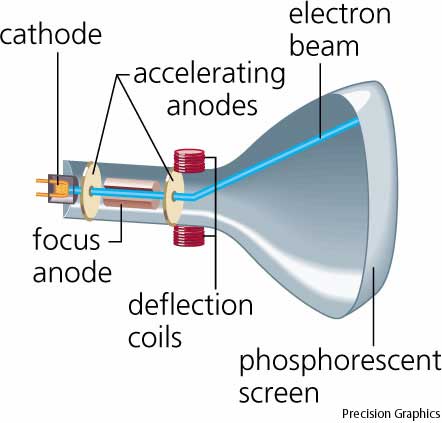
Diagram showing the basic set up of a TV picture tube.

To this day, I don’t understand any of this.  To me, here is how it works:

Your author’s basic understanding of television technology.

We all know the power of television.  Dress up any troglodyte and put him on TV enough, and–PRESTO!–he’ll be elected to public office.  Have you ever been on TV?  Doesn’t it make you feel like you’re just a little better person than you were before?  People will say:  “Hey!  I saw you on TV!”  You could be on TV eating a live squirrel and people would still think:  “Hmmm.  There’s something different about him, now.”  The first time I was on TV, I was probably 8 years old.  It was the Harlan County Poke Sallet Festival Parade.  My brother and I were riding in a convertible.  I think it was John L. Belcher’s car.  If not, it should have been.  It was the kind of car John L would have driven.

Virgil Q. Wacks filmed the parade for his TV show, Virgil Q. Wacks Variety Time.  If you’re not familiar with Virgil Q, I can’t describe his show.  It was a kind of an advertising/travelogue program.  He filmed us in the car and there we were–on TV.  His film collection is archived at East Tennessee State University where we live forever.

There were many disadvantages to growing up in Harlan County, Kentucky, but TV wasn’t one of them.  We had cable.  That’s right–cable TV in the 1960’s  It was the only way to get a TV signal in the mountains.  (As a side note, I am the owner of 1 share of Harlan Community Television, Inc., the longtime local cable company).  In those days, TV channels ranged from 2 through 13, with the little understood UHF channel to boot.  We had signals on all the channels on the dial:  Lexington, Kingsport, Knoxville,  Asheville.  We might have been Ground Zero in the War on Poverty, but by God we won the TV War before it even started.

I loved that color TV.  Eventually, the dial (or channel changer, as I called it)  fell off.  As most families did, we replaced it with a pair of pliers until it could be located, a minor inconvenience.  Sometimes, I would lie on my back and watch the TV upside down just for the hell of it.

I spent many hours in front of that TV. Yes, Batman was in color.  Spectacular color, too.  By the end of the ’60’s, everything was in color! When I was around 8, I started watching sports on that TV.  Hey, kids:  There used to be one Major League Baseball game a week on TV.  It was called, fittingly enough, The Game of the Week.  It came 0n Saturdays, and I always watched.  There was also an NBA Game of the Week.  My earliest sports memory is Wilt Chamberlain and the Lakers vs. Lew Alcindor and the Bucks.   You rarely saw some athletes at all.  The only time you’d see some players would All-Star games or playoffs.  The NFL, being ahead of its time, always had a couple of games on Sundays.

I am part of the TV Generation.  I knew the TV schedule every night of the week.  When I was 3 years old, I surprised my parents by counting to 100 one night.  When my mother asked where I learned that, I could only reply:  “From the TV.”  I was told–and still am–that TV will rot my brain.  Perhaps it has.  I know the lyrics to the theme for Gilligan’s Island, yet I will sometimes forget my children’s birth dates.

One of the calling cards of the intellectual is the refrain that “I don’t watch television.”  I’m not an intellectual, and I do watch TV.  Always have, always will.  I watch sports on TV.  I watch movies on TV.  I watch sitcoms and true crime and reality shows.  I’ll watch anything for a few minutes.  I’ll watch Toddlers & Tiaras just to get outraged.  I’ll watch shows about 900 pound people.  I’ll watch reruns of King of Queens just to marvel at how it could have been on the air for years.  It’s as funny as a truck load of dead babies, but I’ll watch it.  I’ll watch the news, the weather, the History Channel.  I’ll watch Road House for 500th time.  I may know more about the Beverly Hillbillies than any person alive, and I’m proud of it.  TV series, miniseries, short films, previews, reviews–everything.

That first color TV didn’t stay around all that long.  Within a few years, my father enjoyed some financial success, and we had TVs everywhere.  We even got a remote control Zenith.  We had a TV in our bedroom (technically, it was my brother’s).  We had a TV in the kitchen, too. The old TV was relegated to the basement where we continued to use it, but it was now like an old horse put out to pasture.  Like a horse, it sat in that basement for many years after it quit working entirely.

Now, I have monstrous TVs.  46 inch, 60 inch, plasma, LCD, high def–you name it.  Hundreds and hundreds of channels–all at my finger tips.  I not only have a remote control, I have a pillow which doubles as a universal remote. None of them, though, ever thrilled me like the first one.  I’ve loved them all, but none of them–none–ever made me declare that it was the best day of my life.

One day, there may some disaster which destroys society and forces us to start over.  The first thing I’ll do is try to figure out how to build a TV.  TVs–like ships and airplanes–work on some kind of magic, I’m sure.  So, I don’t where I’d start, but I’d get right on it.

Oh, and it would have to be a color TV.

©thetrivialtroll.wordpress.com 2012

Grandma and the Cat Litter Beatdown

This is another largely true story.  This is my Mothers Day story, because it involves someone’s mother.

I knew all the folks involved, so  I guess I believe every word of it.  Like any event I write about it, I hope it’s true.  If not, it is certainly based on a true story, and that’s good enough for me.  I’m not using names in this story, because those involved may not appreciate it.  I hope it doesn’t make the reading too awkward.

I had two or three close friends most of my childhood.  Like most kids, my friends would come and go with the school year, people moving, etc.  I had one friend who was a constant . He lived a few blocks from me, and we spent most of our free time together.

Despite what you’ve seen or heard, Eastern Kentucky is not just shacks and run down trailers.  There are nice little neighborhoods in almost every town.  I lived in one of those.  So did my friend.

My friend lived at the end of a street in a garage apartment next door to his grandmother.  Grandma lived alone in a small but nice house.  That is to say that Grandma lived alone until my friend’s cousins moved in with her.  The cousins were teenagers, probably 15 and 17.  They had moved from “up North.”  Typically, up North meant Michigan or Ohio, where the people talked funny.  The cousins talked funny, too.

The cousins were odd lads.  They didn’t go school.  I never found out what happened–if anything–to their parents.  The cousins just arrived one day.  They delivered the morning newspaper for a while.  When people stopped getting their papers, Dick Russell, owner of a the store where the papers were picked up in the morning, spied on them one morning.  When the papers were dropped in front of his store,  Mr. Russell watched the cousins take the bundle and toss it in the river.  When they didn’t throw them in the river, they dragged the papers along the ground crying as they made their rounds.  Like I said, odd.

My friend was always regaling me in stories of his cousins’ antics.  The cousins were several years older than us, but we took great delight in terrorizing them.  Once, we told one of them that we had put grass and sticks in the gas tank of his car.  Oh, did he get mad.  The joke was almost on us as he lit his cigarette lighter to get a better look in the tank.  Our screams of terror made him drop the lighter.  Again, odd birds they were.

One of the cousins, in particular, was a bit of a thorn in the side of his uncle (my friend’s father).  Now, I don’t know if he actually did anything to merit this or if the Uncle was just generally disagreeable.  Regardless, it was a bit of ritual for the Uncle to castigate the Cousin when got home from work.  Usually, this centered around the Cousin being lazy and good-for-nothin’.  I witnessed this several times myself.  Normally, it started with the Uncle getting out  of his truck and greeting the Cousin with something like, “What in the hell have you been doing all day?  Pick up this stuff up out of the yard!”

So it went one fateful afternoon.  There was a driveway leading from the street to the garage on the left side of Grandma’s house.  The drive was about 75 feet long.  The Uncle parked his truck right in front of the garage.  He got out of the truck and slammed the door.  He immediately spotted the Cousin reclined at the bottom of a tree enjoying a cigarette.  “What the hell are you doing? Clean all this up!”  The Cousin had been working on some type of project requiring the dis-assembly of various small engines.  Apparently, he had lost interest or direction during the project and abandoned it.  The Cousin only responded that he was “working on it.”

This did not sit well with the Uncle, who glared but said nothing.  The Cousin–perhaps emboldened by the silence–yelled “You can’t tell me what to do!!”  The Uncle would have no more of his insolence.  A great shouting match ensued with each hurling threats and invectives toward the other.  Finally, the Uncle removed his glasses and headed toward the Cousin.  It appeared that the Cousin was about to get taught a bit of a lesson.

The Cousin hopped to his feet and looked about for anything with which to defend himself.  There were no weapons to be found, only random engine parts.  What would he do?  Then, he spotted Pedro, the family cat.  In a move which can only be described as a combination of madness, desperation and admirable creativity, he scooped up Pedro with one hand.

There was a bucket beside the tree.  I know this is true, because I had seen that bucket many times.  It was like a big paint bucket or maybe a drywall bucket.  It was full of water.

Often, heroic acts are performed not because the person is brave or fearless but because the person is in a situation where only a daring act can spare him.  Such was the case here, I believe.  By the time Pedro was in the Cousin’s grasp, the Uncle was mere 10 feet or so away and closing quickly.  The Cousin spotted the bucket, and without any apparent thought, dunked Pedro into the stagnant water.  In one motion, the Cousin pulled Pedro from the water and threw him at his would-be attacker.

By all accounts, Pedro hit the Uncle in the chest, claws out, tearing into his shirt.  This did nothing to stop the Uncle’s advance.  The Uncle wrenched Pedro from his shirt and tossed him on the ground.  The Cousin, though, had made a run for the back door of Grandma’s house.  He was not quick enough, and the Uncle cut him off.  The Cousin now ran to the other side of the truck.  The combatants were on opposite sides of truck.  Each move by the Uncle was met with a counter move in the opposite direction by the Cousin.

Grandma, being advanced in years and hard of hearing, had missed most of the action; however, she now emerged from the backdoor.  (As an aside, in all the years I knew my friend, I only saw her once or twice.  I had images of Norman Bates’s mother in her rocker.)  She tottered down the three or four steps to see what was happening.

The Cousin was in again dire straights, trying to keep himself on the opposite side of the truck from his uncle but the Uncle was relentless.  Underneath the steps which went up to the garage apartment were several bags of cat litter.  The Cousin grabbed one and ran from behind the truck. Here came his uncle. Like an Olympic hammer thrower, the Cousin twisted sideways with the bag at arms’ length.  He then swung forward with a mighty heavy toward his uncle, letting the bag fly.

The Uncle ducked.  Grandma, again being advanced in years, did not.  The cat litter bag caught her right in the old bread basket.  I was told that you could hear the air come out of her on contact.  Doubled over, she folded in half and hit the ground.

Say what one will, the Cousin loved his Grandma and was horrified.   He ran toward her, screaming “GRANDMA!”  This was a mistake.  The Uncle caught him with a really nice punch right in the middle of his face, breaking his glasses in two.  He fell to the ground and cried quite a bit.

Oh, Grandma.  She was okay.  Just had the wind knocked out of her.  Surprisingly, there were no broken bones or internal injuries.  She didn’t even go to the hospital.  Pedro was fine, too, although I’m sure he was traumatized by the whole experience.  I’m pleased to say the both Grandma and Pedro lived several more years after this. As far as I know, Pedro was never again used as a weapon and Grandma was never again violently assaulted.

Over the years, I came to realize that the cousins were alright.  They weren’t even all that odd.  Just a bit different. 

So, I guess that’s the end.  I don’t really have an interesting way to end the story.  The late, great Michael O’Donoghue once  noted that poor writers don’t know how to end their stories.  When stumped, he suggested this sentence: Suddenly, everyone was run over by a truck.

 Since my story is set in Eastern Kentucky, here is the ending:

Suddenly, everyone was run over by a coal truck.  The end.

©thetrivialtroll.wordpress.com 2012

What’s in a (Nick) Name?

Why don’t I have a nickname?  Someone posted on Facebook that an American Idol contestant was “Mr. Yummy Pants.”  It got me thinking about nicknames.  I’m not sure I’d like Mr. Yummy Pants, but I might be willing to try it out.

I don’t have a nickname.  This troubles me or at least it used to.  I wanted a nickname.  Something cool like Buzzsaw or Rip.  Nothing ever stuck.  When I was a lad, I had very blonde hair.  As a result, I was occasionally called Blondie.  Not very clever, huh?  Also, not very manly, not that I was particularly manly then or now.

Your author back in his tow-headed days pondered why he had no nickname.

A couple of people used to call me Harlan because I’m from Harlan County, Kentucky.  One was a college classmate.  The other was an old boss of mine who couldn’t always remember my name.  I’m glad that one didn’t stick.  I’m from Harlan County, not the town of Harlan.  I’ve never lived in Harlan.  I didn’t go to school in Harlan.  I lived in Loyall.  Calling me Harlan makes as much sense as calling someone from Louisville “Jefferson.”

Growing up in the 1970’s, I was often called “John Boy.”  Much to my chagrin, my wife often calls me that, too.  I had no interest in being the namesake of one of the pathetic Walton clan.

Why did I want a nickname?  I don’t know.  Maybe it’s because I have a very vanilla name.  It’s so vanilla that I am a life member of the TSA “Watch List,” meaning that I can’t check in on-line for airline flights.  They have to eye-ball me to determine my dangerous propensities.

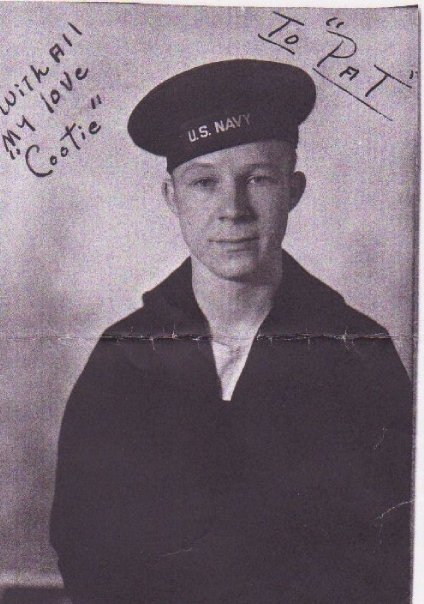
I think the primary reason is that I grew up in Eastern Kentucky, the Land of Nicknames.  My dad had a nickname–two, in fact.  People who grew up with him called him Cootie.  Lest you think this was because of a hygiene issue, it was not.   Dad played the cornet and trumpet.  There was a famous cornet player named “Cootie;” thus, he was Cootie, too.  He was also called Sherm, mostly by one of his brothers.  This had something to do with Dad being interviewed on the radio to discuss his fictional war exploits.  For the interview, he adopted the nom de plume Sherm Cuffs.

My father when he was known to the world as "Cootie."

My uncles had nicknames.  Jack was called Powd.  This came from his mocking of how a neighbor pronounced her dog’s name, “Powder.”  Paul was called Meek.  I never knew why, but I assume it had something to do with being the youngest of seven children.  I have a cousin that people called Bird Neck.  Another is called Tee.  Yet another is Pie.  Good God, even my brother’s wife has a nickname.

Harlan County was a nickname paradise.  There were Slop Daddy (aka Slop Jar); Mighty Moe; Bubby; Foots (aka Feets); Crip; Humpy; Deacon; Hoss; Dirty Ears; Preacher; Night Rider; Bucky; Rubber Duck; Doc; Courthouse; Tiny; Big D; Ring Eye; Clunk; Peanut; T-Bone; Hambone; Bones; and many, many variations of Junior.  One would think I could have picked up a cool name, but it didn’t happen.

Another factor is that I work in the coal industry, THE number one nickname industry in the world.  EVERYONE has a nickname.  Here’s a typical discussion between me and a mine employee:

ME:  “Okay.  You muck the No. 1 belt.  Do you know the belt foreman, Joe Jones?

MINER:  “I don’t believe I know him.”

ME:  “Well, he’s the foreman on your shift.  You have to know him.”

MINER:  “Oooohhh.  You mean Whirlybird?”

ME:  I guess. Is he the belt boss?

MINER:  Yeah, but everybody calls him Whirlybird.  I ain’t never heared him called anything else.

This has been repeated many, many times.  I always feel a tad inferior because I can’t respond with something like:  “Hey, they call me Crow Bar.”

A major problem for me is that I have no distinctive traits.  I am not a handsome man, but I’m fortunate that I do not have any obvious deformities.  Thus, names like Humpy (he was a hunchback) are out of the question.  Lefty won’t work (right-handed).  I’m a small fellow, but Tiny won’t work, because I AM tiny.  Tiny is reserved for people who are behemoths.  I don’t have red hair; thus, the ubiquitous “Red” is out.  I have small hands and feet, but I reject “Tiny Hands” for obvious reasons.   Coming from German and Welsh stock, I have this homogenous Aryan look to me, which is of no interest to anyone save possibly Mel Gibson.

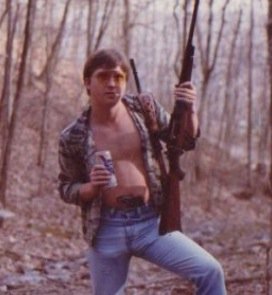
I did, however, look like this at one time:

Inexplicably, your author's ghastly appearance led to no lasting nicknames.

One would think that a nickname would have naturally developed.  Alas, there is a fine–but important–difference between nicknaming and name-calling.

I also have done nothing spectacular in my life to get a nickname.  I heard of guy that got nicknamed Gizmo because of his inept handling of a situation.  I could be called Good Student or Mr. Punctual.  Nothing seems to work.

If I had been an athlete, I could have had something cool like The Eastin Assassin (Larry Holmes); The Brockton Blockbuster (Marvin Hagler); The Iron Horse (Lou Gehrig); The Worm (Dennis Rodman); Magic; White Chocolate; Crazy Legs; and many others.  Based on my athletic skills I would have been something like “Slow Foot” or “Easy Out.”  No good.

A nickname has to fit, too.  I knew a guy named Hoss.  He was a hoss alright.  I have a friend called Wishbone.  It fits him for some reason.  I don’t think anything ever fit me.  When I had braces, my little brother called me Long John Silver Teeth, but that’s too long even though it did sort of fit.

You also can’t give yourself a nickname.  It’s doesn’t work.  In an episode of Seinfeld, George wants to be called T-Bone.  It doesn’t take.  I know a guy nicknamed T-Bone.  I’m sure there’s a story behind it, but I’m also sure he didn’t give himself that name.  I thought perhaps will.i.ams would be cool, but turns out it’s pronounced “Williams.”  Curb Stomper is cool, but I’ve never curb stomped anyone.  I’m much more likely to be tagged with Curb Stomped.  I knew an Irish lady who called my Wee John, but I just can’t support that.

So, I’ve abandoned my quest.  Hopefully, I won’t get hung with a nickname at my age.  Then again, maybe Mr. Yummy Pants will catch on.

©thetrivialtroll.wordpress.com 2012
March of Folly

INTRODUCTION

This story may well be true.  It also may be completely false.  In all likelihood, it’s partially true; thus, I consider it to be based on a true story.  This gives me literary license to fill in blanks and outright fabricate portions of it.

This is based upon a story I’ve heard twice–from two different sources.  One was a person I know well and trust.  The other was someone I barely know.  The essential facts were the same, but there were differences in time, location and other minor details.  It could be that the whole thing was made up.  I don’t know.  But I do know that I like the story, so I’m going to tell it.

As with my other blogs, I’ve changed the names of those involved.  So, if you have a relative called June Bug, that’s not who I’m talking about it.  One name I didn’t change is “Lonzo.”  Lonzo is a shortened version of Alonzo and is a fairly common name in Eastern Kentucky.  In fact, growing up, I knew several people named Lonzo.  Once I left Eastern Kentucky, I never met anyone else by that name.  It’s a good mountain name and fits the character in this story.  The story would lose something if I changed it.

Much of the dialogue is mine.  Some was recounted to me in the story.  Other parts, I made up trying to fit it with the characters involved.

Finally, do not interpret this tale as glorifying or promoting animal abuse.  That’s not what it’s about, although there is a tragic accident at the heart of the story.  I know a lot of folks who like animals more than they do people.  I’m fine with that.  BUT, if you suffer some sort of trauma and go mental reading this, please do not direct your bile toward your author.  I am merely your narrator.  Thank you.

PURDY

Purdy was a mule or probably a mule.  He could have been a donkey or jackass for all I know, but they called him a mule.  “They” were the Harringtons, which was pronounced “Hairnton.”  There were three Harrington boys:  Lonzo, Terry (pronounced “Turry”) and Junior (also known as June or June Bug).  They lived with their daddy, AC.  No one knew AC’s full name (if he had one), although June Bug was in all likelihood named after them.  The boys had a mother, but no one knew where she was.  Rumor was that she just left them, but some folks said there was an incident with her being hit with a shovel.  It doesn’t really matter.  She was gone, and it was just Daddy and the boys.

They lived on the Poor Fork of the Cumberland River in what most people would call a shack.  The house was down off the highway on the other side of the river.  They had about a half-acre of land connected to the highway by a bridge.  The bridge was one of those homemade bridges you see in the mountains.  It consisted of a couple of I-beams with wood laid across for the driving surface.  It spanned from creek bank to creek bank and was supported at each end by cinder blocks.

The house itself was three rooms, a bathroom and a kitchen.  The front room was sort of a sitting area with a TV.  The kitchen was in the back toward the left.  The two bedrooms were in the back to the right.  Daddy had his own room.  June Bug and Terry shared a room, and Lonzo slept on the couch in the front room.

None of these folks had jobs, of course.  Daddy had worked in the coal mines at some point in the distant past.  Lonzo had been in the Army for two years before he was unceremoniously discharged for some disciplinary reason.  Terry and June Bug pretty much did nothing.  Between Daddy’s disability check and Social Security, they got by.

Daddy had one possession that he valued–Purdy.  As I said, Purdy was a mule.  They also had a few chickens and, from time to time, a hog.  But Purdy was a constant having been around for many years.  At one time, he was used to plow Daddy’s small garden, but he had foundered at some point and didn’t do much of anything now.  Daddy didn’t have much use for his offspring, but he loved old Purdy or at least really liked him.

DADDY GOES TO TOWN

Daddy made fairly frequent runs to town for various things, picking up a check, buying groceries, etc.  It was a Saturday in October, and Daddy left in the morning.

The boys rarely went anywhere.  They mostly sat around and drank.  Lonzo was the oldest by two years.  Then came Terry, and two years after him, June Bug.  Lonzo would have been considered the brains of the group, but that’s only because of his ill-fated stint in the Army.  He was about 6 feet tall and wiry thin (we called it “squirrelly-built”) with long, greasy black hair pushed straight back behind his ears.  He had that hard, flinty look that only people in Appalachia have.  Terry and June Bug could have been twins.  Both were short with beer bellies and a penchant for going shirtless most of the time. They had fat, red faces and bushy blonde hair.  There were substantial paternity questions regarding Lonzo, but no one ever asked.

The boys also rarely got out of bed very early, and this Saturday was no different.  Lonzo rolled over on the couch when he heard a commotion outside at around 11:00.  He got up, lit a cigarette and walked out on the porch just as June Bug was running from the back of the house toward the creek with a coil of rope under his arm.  Terry came running from the other side of the house.

“Hey!  What the hell’s goin’ on?”  Alonzo inquired.  Terry stopped, breathless of course, and said “Looky yonder!”  He nodded his head toward the creek.  In the middle of the creek, still as a statue, stood Purdy with water up to his belly.  “I’ll be flat damned,” Lonzo muttered. “How in the hell did that happen?”

Terry responded:  “Don’t know.  June just seen him out the winder.  Just froze up right there.”

“Well, what are you boys doin’?”  Lonzo asked.  Terry said, “June’s made a lassoo and’s gonna lassoo him!”  Lonzo rubbed his beard stubble and took a long drag off his smoke.  “I reckon that might work.”  Terry headed down to the creek with Lonzo right behind.

By the time they covered the 100 yards or so to the creek bank, June Bug had already fashioned a crude lariat with a slip knot.  He was unfurling the rope.  “I’m gonna lassoo his ass and haul him in.”  He twirled the rope as he had seen cowboys in movies do and tossed it toward Purdy. He missed.  He tried again.  He missed again.  Over and over he tried, but with no lucky.  Finally, Lonzo lost patience and said “Gimme that damn rope!”  He, too, tried and tried with no luck.  It should be noted that Purdy stood a good 40 feet from the bank, and the rope was no more than 30 feet long.  This bit of immutable physics was lost on the boys.

They all sat down on the bank and stared at Purdy.  “What do we now, Lonzo?”  Terry asked.  Lonzo responded:  “Hell fire, I don’t know.  All I know is that we better get that damn mule outta the creek before the old man gets back.  He’ll raise nine kinds of hell.”

“You reckon he’s sleepin’?” June Bug asked.

“The damn mule?  Hell, no.  He’s standing up” said Lonzo.

“He’s sleeps standin’.  I seen him do it.”  June Bug said.

Lonzo turned at looked at June Bug.  “Is that what you do with yoreself?  Stand around watchin’ a damn mule sleep?  I don’t know if he’s asleep, but I do know he’s in that damn creek, and, by God, we gotta get him out.”

Terry then observed, “He got hisself in there.  I figger he’ll find his way out.”

This was the last straw for Lonzo.  “This right here is what’s wrong with you fellers.  Quitters.  I ain’t no quitter.  I’m gettin’ that bastard outta there!”

THE BEST LAID PLANS

After being chastised by Lonzo, the boys just stared at Purdy for a few minutes.  Then, Lonzo saw the answer and stood straight up.  “By God, I’ll ride his ass out.”

Terry said:  “How you gonna do that?  Wade out there?”

Lonzo snapped:  “Hell, no!  I ain’t freezin’ my ass off in that damn creek!  I’m gonna shimmy over the side of the bridge and jump on him.  Once I’m on his back, I’ll just ride him out! Let’s go!”

All three got up and headed to the bridge.  When they got to the middle of the bridge, Lonzo looked down and determined that he could, in fact, hang down and drop right on Purdy’s back.  Even if he missed, the drop wasn’t that far, maybe 10 feet at most.  If he landed in the water, he wouldn’t be in it very long anyway.

Lonzo sat down in the middle of the bridge with his feet hanging over.  “You boys lower me down.  I’ll grab aholt of that beam.”  So, the boys did just that. With Terry taking one arm and June Bug the other, they lowered Lonzo over the side.

Lonzo was facing the wrong direction.  He could grab the beam and hang down, but he would be facing away from Purdy.  Riding a mule was likely to be difficult under the best of conditions.  Facing the wrong direction, it might be impossible.

Once he was lowered into postion, Lonzo swung his right hand under to hold both sides of the beam.  Now, he was sideways.  Then, he saw it.  A length of cable ran the entire length of the bridge just inside the beam.  This was perfect.  He grabbed the cable with his right hand and swung his left hand over.  Now, he had a perfect grip and faced the proper direction.  He was perfectly positioned.

Hanging down from the cable, Lonzo was about 10 feet from the water and maybe seven feet from Purdy’s back.  He started to swing back and forth on the cable to get proper momentum for his leap.  After three or four swings, he was ready.  One last swing forward and he let go.

Falling through the air is a funny thing.  Usually, you don’t have time to think about it.  You just fall.  Sometimes, though, you have a moment to consider what’s happening.  I imagine this might have happened with Lonzo.  He may have seen Purdy hurtling toward him, instead of he himself falling to Earth.   At that moment–and just for a split second–he might have realized that this plan was not, in fact, well-conceived.

Ah, but the plan worked–sort of.  Lonzo landed square on Purdy’s back.  There were two sounds:  First, the loud, unmistakable sound of a mule’s back breaking.  Second, Lonzo emitted a long, mournful scream which could only accompany a shattered testicle.

Purdy folded up like a lawn chair pinning Lonzo.  Lonzo, still wailing, slowly slid sideways until he dropped into the water, which was as cold as he feared.  The cold water, though, shocked Lonzo into full consciousness and he stood straight up, only to be doubled over again in pain.  He repeated this cycle as he struggled to the creek bank.  From their vantage point on the bridge, Terry and June Bug thought he looked like one of those toy birds that dips its head up and down like it’s sipping water.  Lonzo made it to the bank and collapsed, doubled over in agony.

The rest of the story is uneventful.  A watery grave for Purdy, a trip to the hospital for Lonzo.  Terry and June Bug did have to get Purdy out of the creek, and they got to use their “lassoo.”  Daddy was mad, as expected, but he got over it.  Lonzo lost a testicle.

CONCLUSION

So, there you have it.  This could have happened.  I knew people who would have done such things.  I hate to think of a mule dying under those circumstances, but life’s not fair.

Oh, what about the title of this blog?  A close friend of mine was so taken by this story when I first told it to him years ago that he wanted us to develop a screenplay based upon it.  He titled our project March of Folly.   I see Adrien Brody as Lonzo, maybe.  Robert Duvall as Daddy.

Sadly, the thought of stretching this out to even a 90 minute film is daunting.  I haven’t given up hope, but we really need to get on it.  Hollywood awaits.

©thetrivialtroll.wordpress.com 2012

The Horrors of Camping

Your author as a mountain man. 1982 on Little Shepherd Trail in Harlan County.

I don’t camp.  That’s not particularly interesting, is it? I also don’t hunt or fish. Mind you now, I don’t have a problem with those who do these things.  I’ve done all three at various times.  As for hunting, it’s kind of fun to walk around with a gun and shoot at things.  I just don’t like dead animals.  They’re gross, especially if you skin them and pull their guts out.  I found that I had no more use for an animal I killed than for one I ran over with my car.  If you like to hunt, that’s cool.  I support you.  Fishing is  just plain boring, but I do understand the appeal.  Like bowling, it’s an activity where being stinking drunk is not a hindrance.  Unfortunately, you still have the whole skinning and gutting thing.  It’s just not for me.  But, this is about camping.

If I may digress for a moment, hiking–camping’s cousin–is okay.  I have hiked quite a bit.  I grew up on the side of a mountain, and my friends and I would often take treks into the woods.  There is a place above my hometown called Long Hollow.  It’s way back in the woods and kinda cool.  There were also old coal mine portals back there and related relics–trucks, picks, shovels, etc.  Occasionally, we would encounter feral dogs which scared the hell out of us.  I liked all that, but it’s not camping.

I grew up in Eastern Kentucky where it is assumed we’re all mountain men.  People assume that I’m a hiker, camper, hunter, fisherman, etc.  I’m not.  I was what was called “book smart.” If you ever call someone “book smart” or say that a person “doesn’t have common sense,”  what you’re really saying is:  “This person is infinitely more intelligent than I am.  I admit this and have no sensible way to counter it.”  Here is an actual discussion I had once with someone, who shall remain nameless for obvious reasons:

Him:  You ain’t got common sense.  You’re just book smart.

Me:  What do you mean?

Him:  All you know is what’s in books.

Me: If you mean I can read, I agree, but you can read, too.

Him:  But I don’t know nothing from no book.

Me:  I’m not following you.

Him:  How do you trap a bear?

Me:  Why would I trap a bear?

Him:  See?

Me: Why not kill the bear?  A trapped bear would be pissed off.

Him:  You don’t know how to set a bear trap.

Me:  I guess I could do that, but don’t you have to kill the bear after it’s trapped?  Seems like you should just shoot the bear and be done with it.

Him:  F*ck you!

That’s pretty much how it went in those days.  Anyway, I HAVE camped.  A few times, in fact.  We  had this huge tent my Dad bought somewhere.  We’d set it up in the backyard and sleep in it.  I liked that kind of camping.  If you get cold, you can go inside.  You get to use plumbing.  Otherwise, I’m not much of an outdoorsman for a number of reasons.

Plumbing:  Indoor plumbing separates us from the animals.  My ancestors didn’t come to this country on filthy, crowded ships just to have me wallow in my own filth for “fun.”  If you are comfortable relieving yourself outdoors, good for you, but that’s not a lifestyle choice I’m ready to make.

Electricity:  I am a HUGE fan of electricity.  Almost everything I do requires electricity.  Central heat and air conditioning requires tons of electricity.  Mother Nature doesn’t.  The result?  Constant discomfort.

TV:  I like television.  There are lots of good things on TV.  Sports, movies, reality TV, weather, news and many other things.  When you camp, you’re cut off from all that.  It sucks.

Filth: In addition to the obvious hygiene issues, I tend to get dirty when I camp, and I don’t like getting dirty.  I don’t mind sweating some and even smelling bad, but dirty isn’t good.  It leads to only one thing: germs.  The more germs you get, the more likely you are to contract some foul and loathsome condition.  For me, to camp is to eventually die.

Wildlife: I have nothing against animals, BUT they’re animals, and I’m not.  They live in their world, and I live in mine.  I don’t expect snakes in my house, so I try to stay off their turf, too.  You know what poses no problem for a snake?  Tents and sleeping bags.  Same goes for bears.

Plant life:  Aren’t the plants and flowers beautiful?  Of course they are.  Right up until you get into poison ivy or poison oak.  You can eat hemlock or belladonna or something else which will cause you a slow, agonizing death.  Before you die though, you’ll soil yourself, stripping you of your last shred of dignity.  Fun stuff.

My last camping excursion ended camping for me for good.  I was 14 years old and my friends, “Bobby” and “Steve” (These are there real names.  Read on, and you’ll see that they don’t deserve anonymity), asked me to go camping.  I didn’t really want to go, but I agreed.  How bad could it be?  Pretty damn bad, as it turns out.

It was the first Saturday in April, 1977.  We went to an area above Sukey Ridge in Harlan County.  Later, this area would become better known as the Blanton Forest, reputed to be the oldest old growth forest in  universe or some such distinction.  (By the way, the forest would be much larger if some of the Blanton descendants hadn’t logged it, but that’s for another time.)

Anyway, we hiked back into the woods, a couple of miles maybe.  I had a Vietnam War issue rucksack which must have been made of cast iron.  It felt like it was filled with bowling balls.  I assume it was designed to make our soldiers as miserable as possible.  My cousin was a Green Beret and brought it to me straight from Nam.  He also gave me a big, 10 inch knife.  I carried that, too, along with a pilot’s survival knife.

“Lightweight” tropical rucksack used in Vietnam. Full loaded it weighed more than I did.

We hiked way back in the woods.  I have to say, it was beautiful.  Big, old trees and a creek running through the woods.  Very nice–for a while.

First, the rednecks showed up.  Just as we found us a nice cave to stay in for the night, we heard the roar of motorcycles.  Three guys, probably in their twenties, came roaring into our campsite.  They were there to party.  Fortunately, there was another cave down below ours and they settled into that.  Other than the constant stench of marijuana emanating from their camp, they seemed harmless enough.  The leader of the pack told me that he wouldn’t give us any pot, because he had a brother our age and he wouldn’t want him to be “smoking dope.”  Fair enough.  He was a man of some honor evidently.

The bikers would have been okay.  They seemed content to keep to themselves, except for one of them who visited us late in the night to see if we had a gun.  That was a little creepy.  I had seen this guy before.  Sometimes, he rode his bike behind our school bus and flipped the bird to the kids in the back.  Nevertheless, the bikers weren’t the problem.  The rain was the problem.

Nowadays, I suppose the Weather Channel and sophisticated radar would prevent three teenage boys from heading 2 or 3 miles into the woods into the teeth of the heaviest rainfall since Noah was trying to figure what the hell a cubit was. We had no such luck.

Late in the day it started raining.  This was a rain like I’d never seen.  It poured, sheets of rain.   Of course,we needed a fire to stay warm, but we couldn’t build one outside.  So, we started one in our cave.  (Honestly, it was more of an overhang than a cave).

Steve was a damn Boy Scout, and he was supposed to know this stuff.  He camped all the time.  If I had thought about it, I would have realized that the cave did not have a flue.  With the knowledge I have today of underground coal mining, I would now immediately recognize that we had inadequate ventilation and that the air would reverse on us.  All we needed was a strong fan and a few ventilation curtains. Alas, I had no skills to prevent what happened next.

Funny thing about thick smoke, it’s very difficult to breath.  You’ve heard of people dying of smoke inhalation?  By God, they do.  And it doesn’t take very long, either.  The good thing is that if you are asphyxiating from a fire right next to a driving rain storm, it’s pretty easy to put out.

After we put out the fire,  it took a little time to get the smoke out, but we did it.  My eyes were watering, and I smelled really bad–like a stinky cave fire.

Since we were stuck in the cave with nothing to do, it didn’t take long for us to eat what little food we brought.  I’m not sure why I didn’t have more food–maybe I planned to forage off the land.  In any event, I was down to two Payday bars.  It started to get cold, too.  Did I mention the rain?  If you had to pee, you could just stand there and pee in your pants.  It wouldn’t make any difference.  You were soaked regardless.

The cave was also dirty, what with it being a cave and all.  The soot from the fire didn’t help things.  Sleeping there was like just lying in a fireplace.  I lay there, nibbling on a Payday, planning to kill and eat one of my companions if it came down to it.

My lips got chapped, too.  I mean damn chapped.  Cracking chapped.   Bleeding chapped. Hurting like hell chapped.  Did I mention the rain?

Well, it rained all night.  When we woke up it was still raining.  At some point, we headed out.  I recall that Bobby’s dad was meeting us somewhere to give us a ride.  As we hiked out, it rained on and off.  I didn’t care anymore.  I had no more dignity.  I was tired, hungry, filthy.  Oh, and my lips were really chapped.  Bad ass chapped.

It kept raining and raining and raining.  It rained nonstop all Sunday and into Monday.  By Monday afternoon, Harlan County was almost completely underwater.  My hometown looked like a lake.  My fantasies of being back in a warm home were scotched by the biggest flood in the history of our county.  No electricity.  No water.  Back to roughing it, but it could have been much worse.  At least our house was high and dry.  Many of our friends weren’t so lucky.

Ironically, as an adult I love to watch survival shows on TV.  Man vs. Wild, Dual Survival, Survivor Man, Man Woman Wild–you name it–and I’ll watch it.  I learn how to distill urine into drinking water, start fires with sticks, kill porcupines, purify water and many other valuable life saving skills, none of which are likely to be necessary sitting in my chair at home.  You want to teach me a skill I could use?  How about fashioning a satellite dish out of a pile of sticks and rocks so I can watch Sports Center?   THAT could come in handy.

Oh, to this day I’m addicted to chapstick.  It’s a constant reminder of that weekend.  It took me many years to eat another Payday.  When I do, I taken back in time to the cave.

My idea of roughing it today is no HD TV or poor cellphone reception.  I never did learn how to trap a bear, although I’m still confident that shooting a bear is a much better approach.  So, don’t ask me to go camping.  I won’t do it.  I’ve served my time as an outdoorsman.  Now, what’s on TV tonight?

©thetrivialtroll.wordpress.com 2012

Richard Kent Williams (March 16, 1967 – September 26, 1987)

August 11, 1987. Richard (left) and our parents help me celebrate my 25th birthday. Six weeks later, Richard would be dead.

Richard Kent Williams was five years younger than me.   He was my brother, and he’s been dead for over 25 years now–more than half my life.  “Been dead” isn’t exactly right.  He is dead.  It took me a long time to say that.   Passed, passed away, gone or lost were much gentler terms.  Eventually, I could say that “he died.”  Something about the past tense took the edge off it, as though one could die and that be the end of it.  This ignores the obvious:  those who die remain dead.  They are dead.  That’s the case with my brother.  He would be middle-aged now, but he isn’t.  He was 20 when he died, and 20 he remains.

Richard died in the early morning hours of September 26, 1987, but I’ve always thought of the 25th as the right date.  That was his last day.  He was a student at the University of Kentucky.  He came home to Harlan County for the weekend.  He had a rented tux in the back of his car.  He was going to be in wedding.  His last day.  He didn’t know it, but that was it.

My phone rang at 4:47 a.m. on the 26th.  It was my older brother, Tom:  “There has been a terrible tragedy….”  The rest is now just white noise.  Richard was dead.  He died in the parking lot of a movie theater in Harlan, Kentucky.  It was a handgun accident.  The details have long since become insignificant if, in fact, they were ever significant.  I called my parents.  As I expected, my mother couldn’t speak.  My dad spoke in an eerie, flat tone, almost devoid of emotion.  He said to hurry home but take it easy.  My dad was a tough guy.  I had never seen him upset.  Angry maybe but never emotional.  He just sounded tired.  Very tired.

I left Lexington with my girl friend (now my wife of over 25 years).  I’m sure I was in a form of shock.  Bursts of emotion were followed by almost a catatonia.  I just kept driving.  I didn’t know what to expect at home, but I knew it would be bad.  After our 3 hour drive, we got to my parents’ house.   I recall that there were a bunch of people at the house.  The first person I saw was my Dad.  He was standing in the kitchen, hands on the countertop staring straight down.  He turned and looked at me, his eyes glazed over and red.  “I can’t take this.”  That’s all he said.  This was worse than I expected, because if he couldn’t take it there was no chance for me.  Honestly, I don’t know what happened those few days until the funeral.  I know that Dad and I got Richard’s car from that parking lot.  We picked up his clothes from the funeral home.  There was a visitation and a funeral.  Lots of relatives came from near and far.  That’s about all I remember.

In my favorite film, Apocalypse Now, Col. Kurtz describes a massacre and says:  “I cried like some grandmother.  I wanted to tear my teeth out.  I didn’t know what I wanted to do.”  That perfectly describes those days.  None of us thought we’d survive it, but we did. We all did.  The world didn’t stop.  The mail ran.  Banks were open.  People went to work, to school.  Our world had stopped spinning, but the rest of it was humming along.  At some point, the inertia of that world carried us forward.  Dad said that going to Harlan was like “running the gauntlet.”  He was so weary of people telling him how sorry they were.    Mom stayed home, which was pretty much what she always did anyway.  One day, Dad told me that “there’s no such thing as not taking it.”  I knew he would move on.  For Mom, it always seemed to shadow her but she, too, continued on.  It got worse before it got better, but it got better.

We moved on.  A month after Richard died, I was sworn in as an attorney.  Four months after that, I got married.  Tom’s son, who was 8 at the time, is now a grown man in his 30’s with 2 kids of his own.  I have 3 sons, the oldest of whom (whose middle name is Richard)  is now older than Richard was when the clock stopped on him.  Mom died in 2003.  Dad in 2008.  Our grandfather died in 1998. Our Uncle Jack, who provided us with so many laughs as kids, died In 2013. We’ve also lost other aunts and uncles in that time.  Life did go on.  Cell phones, satellite TV, HD TV, the Internet, email, texting, another space shuttle explosion, 9-11, three wars, UK won three NCAA titles, and many, many other things happened.  The world is a much different place than it was in 1987.

Those who die young become tragic figures, often mentioned in hushed tones.  Sometimes, they are cautionary tales.  Sometimes, they are examples of the unfairness of it all.  My mother had two uncles who fell into this group.  Uncle Ollie was 18 when died on the USS Houston in the Battle of the Tonkin Sea in 1942.  Uncle George died when he was 8 of liver failure.  He died in the car while his parents were driving him to a specialist somewhere up North.  “Poor little George” was how he was described.  I hated hearing about him.  It was just too sad.

Richard became “Poor Richard,” part cautionary tale, part unfairness.  In hindsight, I came to view his death as a sign of the ultimate fairness.  No one is immune from pain.  We’ll all get a dose of it.  It isn’t my intent to offer anyone grieving advice.  I have no magic pill.  We all grieve, and  I suspect that it’s different for each person.  I don’t know how  other folks feel, and they don’t know how I feel.  We all soldier through the best we can.  I lack the abiding faith that some have that the dead “go to a better place.”  Perhaps that’s because I’ve never heard anyone say:  “Well, Grandpa just went straight to Hell.” Seems like everyone goes to a better place.   Some days I think of “a better place.”  Other days, I just think dead means dead.

Other times, the dead become saints.  Now, this is usually reserved for older people, but let’s be serious.  Not everyone was a great person who will be missed by all.  As my Dad said of a friend of his:  “His headstone should read:  He will not be missed.”  Yet, we canonize our loved ones.  It understandable.  But, c’mon, someone has to go to Hell, right?  Just not anyone I know.

You may be asking:  What is this blog about?  Here’s the deal:  Richard isn’t a tragic figure nor was he a saint.  He was a 20 year old young man who died.  But, before he died–and stained his memory–he was just a person.  I forget that sometimes.  I’ve made a point with my kids to never treat him as a shadowy figure, although to them that is surely what he is.   Here’s what he was:

  • He was born on March 16, 1967.
  • He was a small guy 5′ 5″ 130 pounds.
  • He looked like my Dad.
  • He was funny.
  • He could be short-tempered and profane.
  • He could fight.  I mean REALLY fight.  You’d need to be twice his size to have a chance.  He had lightning quick hands and could throw punches like a boxer.
  • He was one of those guys who never got injured.  My middle son is like that.
  • He was probably the strongest person in the United States for his size and age.  Seriously.  He was the national high school powerlifting championing and collegiate powerlifting champion at 114 pounds.  He could bench 260 pounds and deadlift 400.

Sports Illustrated, July 1985

  • He once put a block of wood in one hand and drove a two inch nail into a 2×4 with two  hits.  Try that.
  • He kept his teddy bear in his bedroom until the day he died.  Teddy stayed in my parents house until Dad died.
  • He was a huge fan of every 1980’s hair band
  • He liked guns
  • He liked cats
  • He was fiercely loyal to his friends.  He fought with them and for them.

Those are just a few things.  Frankly, my memory fades over time, but I can still hear his voice.  I can see his smile and hear him laugh.  He was just a regular guy.  Sometimes, I wonder what he would be like now.  Of course, that’s a futile exercise.  I might as well wonder what I would be like if I had been born in the 1920’s.   I wasn’t, and he won’t ever be 40 or 45 or 50. He’s 20.

August 11, 1978. Richard (and Teddy) and Tom celebrate my 16th birthday. Teddy would “live” in that house for another 30 years.

Like most folks my age, I’ve had my share of grief.  My parents died.  A close friend died unexpectedly.  Nothing ever hit me like Richard’s death.  It still resonates but doesn’t really hurt.  It’s  like getting hit with a hammer.  It would always hurt, but if you got hit with it everyday, you’d get used to it.  I got used to it over time.

Tom and I serenade Richard on his first birthday. March 16, 1968

I would like to say that his death seems like yesterday.  It doesn’t.  It seems long ago, enveloped in the fog of a bad dream.  His life, though–that’s still fresh. He were kids together.  I was his big brother, and I always will be.  I wonder some time if he’d recognize this old man.  He’d probably give me grief about all this gray hair.

When Dad died in 2008, the jacket Richard was wearing when he died was still hanging in the hall closet.  My brother and I just stared at it.  Then, one of us decided to just toss it in the casket with Dad’s body.  Oh, the teddy bear was still there, too.  Teddy got a ride in the casket, too.  After that, some 20 years after Richard’s death, it seemed over.  After all, we wouldn’t bury Teddy for nothing.  Richard is dead, but that’s okay.  It happens to all of us.  It just happened to him too soon.

©thetrivialtroll.com.wordpress.com 2012

Hitchhiking In Harlan County

Typical modern day hitchhiker

What happened to hitchhikers?  You don’t see them anymore.  They used to be quite common.  I grew up in a town called Loyall in Harlan County, Kentucky.   Loyall was, and is, the proverbial town with one red light.  When I was growing up, there was a store/soda fountain on the corner at the red light.  It was named, fittingly enough, The Corner Store.  John and Goldie Roaden owned it.  You could get two hot dogs and small Coke for 60 cents.  Hitchhikers would often work the road just up from The Corner Store.  Thumbs out, they waited for a ride.  If you knew the guy, you’d pick him up.  Even if you didn’t know him, you might pick him up anyway.  By the way, we called it “thumbing,” which sounds vaguely obscene, but that’s what it was.

Now, in my family, hitchhiking was unheard of.  It was one of the many activities reserved solely for the “lowest of trash.”  My mother relegated many things to the lowest of trash–smoking, cursing, drawing on yourself, fighting and associating with trash, to name just a very few.  My father would gladly pick up hitchhikers.  In fact, even late in his life, he would occasionally pick up someone.  This would invariably be a notoriously dangerous person.  He would say something like:  “I gave [FILL IN NAME OF DANGEROUS PERSON] a ride yesterday.  You know, he’s an outlaw, but he thinks a lot of you.  I was telling him all about you.”  I would just think:  “Geez, Dad, don’t tell that dude anything about me!  He might come and kill me.”  Oddly enough, I had a brief foray into hitchhiking myself.

I had a friend who liked to hitchhike. He’ll rename nameless for this story.   He was a funny, funny kid.  Now, he was not the lowest of trash, but he was the kind of kid  who wouldn’t hesitate to engage in any number of prohibited activities.  He would steal his mother’s cigarettes and light one up to show how cool he was.  A 5 foot tall middle schooler smoking his mom’s Virginia Slims may not sound cool, but he pulled it off.  I, on the other hand, was a good kid.  I did well in school and never got in trouble, but I always had a friend or two who lived on the edge.  For a long time, this guy was that friend.

When we were in the 8th grade, we decided that we were too old to ride bikes and should start hitchhiking.  My initial reaction was about how I would have reacted to the suggestion of human sacrifices.  No way, no how would I do this.  I would get caught, because I ALWAYS got caught.  No way.  So, of course, I headed down to The Corner Store with my buddy to thumb to Harlan.  My pal played baseball and was wearing his uniform.  I figured that was pretty safe.  We had our thumbs out for about 5 minutes when Mrs. Thornton, my 6th grade teacher, gave us a ride.  She lectured me the entire way to Harlan about the dangers of hitchhiking.  I figured she’d call my parents, but she didn’t.  We even hitchhiked home after the game.  Some old guy gave us a ride.  No sweat.

We continued our thumbing lifestyle for weeks.  Usually, someone we knew picked us up.  Even strangers were nice to us.  Then, things got weird.  One night, we got my parents to drive us out to the carnival which was set up in the parking lot at James A. Cawood High School.  We told them we’d get a ride back.  My parents weren’t concerned about me–they assumed I had good sense.  When we left the carnival, it was dark, and of course we didn’t have a ride.  We were about 5 miles from home, and old friend wanted to hitchhike.  At this point, you should know that I was far from being a  rough, tough Harlan Countian.  The thought of hitchhiking in the dark terrified me almost as much as the thought of walking home 5 miles in the dark.  We decided to start walking–with our thumbs extended.  We reasoned–quite logically–that we were kids and someone would pick us up.  I can still hear cohort say:  “Man, we’re little kids.  Someone will pick us up because they’ll be worried about us.”  That made some sense to me, proving that my parents’ faith in my judgment was sorely misplaced.

We had walked about a mile when the brake lights on a car popped on.  I knew this car.  It listed to one side like a ship about to capsize, but I knew why the car leaned to one side.  I said:  “Hey, that Jimmy Meeks.”  My friend said:  “So what?  He’ll be going to Loyall.”  Jimmy Meeks was a giant.  Anyone reading this who knew Jimmy would agree.  A giant of the Andre the Giant variety.  I don’t know how tall he was, but he had to be 6′ 5″ but looked a foot taller.  Jimmy told me one time that he weighed 430 pounds.  I’m guessing he fudged a little on that. He had to weight 500 pounds.  He looked like Bluto from Popeye.  He was one of these tall guys with a long torso shaped like a barrel.  Jimmy’s hands were huge.  I saw him take a swig out of a fifth of whiskey once, and I swear his hand went all the way around the bottle.

I want to make one thing clear:  I’m not making fun of Jimmy.  Jimmy had developmental problems of some kind.  He was probably 10-12 years older than I was. Had he been born later, I expect he could have had  the kind of attention that folks get today, and his life would have been easier.  As it was, he struggled.  I got to know him growing up.  He mowed our grass, and we would sometimes give him rides to church.  Many people were terrified of Jimmy.  He was physically imposing but had the demeanor of a child.  Sadly, he frightened people.  Even though I liked him, he kind of scared me, too.  I had heard many stories (most of which were probably untrue) of him losing his temper with people.  I really didn’t want to get in that car, but of course I did.

Jimmy said:  “Where you boys going?”  “Loyall” we both said.  Then Jimmy lit into us about the dangers of hitchhiking and how he should turn us in to the cops.  I said:  “Jimmy, you know me.”  He looked at me in the mirror said “Johnny, I know you.  I’m going to tell your daddy.”  It went downhill from there.  Jimmy then told my buddy that Jimmy had seen him drinking whiskey and would tell his mother.  My little pal was not known for his diplomacy and responds with “Well, I saw you smoking and drinking, and I’m tellin’  YOUR mommy!!”  Okay, you might have guessed, but this was a mistake.  Jimmy exploded, yelling, cussing, beating his basketball-sized fist on the dash.  I’m saying useless stuff like:  “Jimmy, Jimmy, calm down, man.  No one is telling your mom and dad anything.   Ignore him.  He’s an idiot.”  Jimmy now says he’s going to throw us in the river when we get to Loyall.  I’m in the backseat trying to plot my escape. I figure I’ll jump out at some point.  I hate to leave a friend in the lurch, but–hey–no need for two of us to end up in the river.

Now, we’re in Loyall.  Jimmy is still irate.  He had this loud, booming voice that made your head hurt.  He’s still yelling about the river.   Finally, my friend says:  “Hey, you gotta let us out.”  Jimmy just stops the car, and we get out.  Crisis over.  I lean in and say:  “Thanks for the ride.”  Jimmy says:  “Tell your daddy I said hello.  I like him.”  That was it.  Maybe that was a close call.  Maybe not.  But I was sure I was done with night-time hitchhiking.

A couple of days later, we’re back on the road.  Same routine.  Thumb to the ball park and start thumbing home.  No sweat.  We get to the park with no problem.  We then head home, walking and thumbing.  A pick up truck pulls over.  It’s an old truck, maybe 15 years old or so.  California plates.  I got a bad feeling about this.  The guy throws open the passenger door and says “Get in!”  This dude is rough-looking, even by Harlan County standards.  He’s filthy, just dirty.  Greasy, slicked back hair and ratty t-shirt that covers about half his beer belly.  The worst thing is that he looks crazy.  So, of course, we just hop right in.  I’m sitting right beside this filthy, crazy guy, and my friend is beside the door.  Now that I’m right beside the driver, I learn that he also stinks like severe body odor, whiskey and cigarettes.  He puts the old truck in gear.  That’s when I notice the fifth of whiskey between his legs.   My stomach drops.

Filthy Guy:  Where the hell are you going??

Me: Loyall

Filthy Guy:  Where the hell is Loyall?

Me:  Three miles the other side of Harlan.

Filthy Guy: Where the hell is Harlan?

Friend:  Well, where the hell are you going?

Filthy Guy:  I got no idea.

At this point our conversation was interrupted when Filthy Guy spied someone with long, flowing hair walking down the road.  He yells out the window a stream of obscenities intended to express his desire for the person whom he believes to be a young woman.  Naturally, it’s really a man, causing my buddy to burst out laughing and say: “Dumbass, that’s a dude!”  That’s when I saw the gun.  He had it under his leg, and just pulls it out and points it toward us.  It’s a revolver (a .38), and it’s loaded.  That shut us both up.  Now, Filthy Guy has become Dangerous Guy.  He says he ought to just shoot both of us, because he’s just driving through. He could shoot us both, throw us on the river bank and be long gone.  Or he could do a bunch of horrible things to us, then shoot us.  Now what?

Here’s what.  My friend was a quick thinker.  In those days, you had to drive right through the town of Harlan.  There was no by-pass road.  When Filthy Guy slows down at the railroad tracks in Harlan, my friend throws open his door and says “We’re getting out!”  The guy just stops the truck–he’s still pointing that gun at us, and we jump out, running when we hit the road.  Filthy Guy is yelling at us and laughing like a maniac. We walked the three miles home.

That was it for me and hitchhiking.  I didn’t have the stomach for it.  My buddy kept doing it, as did a bunch of other folks.  When I was in my 30’s, I told my Mom that we used to hitchhike.  Her response:  “Oh, Lord.  I had no idea.  Only trash does that.”  True enough, I suppose.

Hitchhiking has changed.  I see the occasional hitchhiker, usually on the on-ramp to the Interstate.  They’re always scary, and I avoid even making eye contact with them.  Even when I go back to Harlan County, I never see any.  I guess it’s a lost art.  It’s probably a valid assumption that hitchhikers and those that pick up hitchhikers are a bit unbalanced.  At least that’s what I think.  That, or they’re just the lowest of trash.

©thetrivialtroll.com.wordpress.com 2012

The Party Monster of Park Hill

I grew up in rural America, Eastern Kentucky to be exact.  To be more precise, I lived in a small town on Park Hill or Ballpark Hill or Ball Park Road, depending on your preference.  I would like to tell you of the hard times and struggles we had, but we didn’t have any of that.  We lived quite comfortably in a nice house and didn’t really want for anything.  One of the great things about my hometown was that it was a melting pot.  Like us, you might live quite well, but your neighbors may not.  Your best friend could live in poverty, but it didn’t matter.  We really didn’t notice or make judgments about that kind of thing, at least not to the extent that I see living elsewhere now.  Having a neighbor who had been shot or shot someone or been to prison wasn’t all that uncommon.  Heck, one of my close relatives was shot by a cop one time.  Occasionally, the melting pot would bring you into close contact with the “wrong side” of the tracks.  For a few years, we lived that experience.  His name was Billy.

HOMECOMING

It was the mid-1970’s.  Billy had been in prison for several years. He was the getaway driver in an attempted murder.  Due to the vagaries of prison rules, he somehow served longer than the actual gunman, who, by the way, was a fine fellow.  His mother, brother (Jeff) and stepfather lived across the road from us.  Jeff was in elementary school, and was a friend of my younger brother. They were a little rough around the edges but good neighbors.  They were the kind of folks who ate souse and ‘mater sammiches and would offer you one.  Good people.

Jeff kept telling us that Billy would soon return home.  I was in front of the house the day he arrived.   His mother’s house set on a little rise across the road (we lived on the side of mountain.  Everything was on a rise.).  His car swerved into their front yard and came to an abrupt halt.  Billy got out, took two steps and collapsed flat on his face.  Out cold.  He laid there for an hour or so until his mother got home.  She roused him, and he staggered to the house.  I assume he was overwrought from the excitement of returning home.

I would guess that Billy was in his late 20’s.  He had long, greasy hair–dirty blonde, with the emphasis on the dirty part.  He was small, maybe 5′ 5″, 120 pounds.  He had that hard, flinty look that only Eastern Kentuckians have.  His eyes were wild.

It didn’t take long for Billy to wear out his welcome with his stepfather.  The first peculiarity was that he rarely slept.  Perhaps he drank too much caffeine or was ADHD.  It’s hard to say.  When everyone in their home went to sleep at night, Billy would hook up a water hose and go about the house spraying everyone down and yelling “PARTY WITH ME!!’ You can imagine how disconcerting this was.  As a result, his stepfather banished him to a metal storage shed behind their house.

Now, Billy was nothing if not resourceful.  Somehow, he got his hands on a long spool of electrical wire and spliced it into the meter box of their house.  He then ran it back to the shed to power a lamp and record player.  At this point, I must comment on his innovation.  I watched him work on this. No insulated gloves.  Smoking and swigging a half pint the whole time.  Anyone else would have been electrocuted immediately.  Somehow, he did it with no problem.  It was impressive.

Now that he had power, he adorned the shed with many, many Playboy centerfolds (and a few pictures of Elvis) and would party far into the night.  He was having a grand time, albeit alone.  As you might expect, there were bumps in road in his transition from prison.  For example, his mother once gave him money to buy groceries.  He went to the store, came home, threw a roll of bologna on the front porch and disappeared for three days.  Then, there was the time he took off on Jeff’s bicycle only to be arrested for drunk bicycling.  Another time, my father spied him siphoning gas from one of our cars.  Dad ran him off.  The stepfather called to apologize, lamenting that “that boy is headed back to prison.”  Dad simply said:  “If he touches my car again, he’s headed to the cemetery.”  Later Billy apologized to Dad, stating:  “I wouldn’t cipherin’ yore gas.  I swear to God.”  Maybe not.  He could have been having a refreshing drink through the rubber hose in his mouth.

His years in prison had hampered his social skills, as one might expect, too.  He had a unique, if combative, way of answering the phone.  Instead of the more traditional “Hello,” he answered with “Yeah?  What of it?”  I’ll admit that my brother and I called their house more than a few times just to hear this.

By and large, Billy’s stepfather kept him in line.  Oh, we’d peer out the window and see him dancing by himself in the moonlight, but he was harmless.  For the time being.

LET THE GAMES BEGIN

After Billy had been home for a year or so, his stepfather died.  Billy moved back in the house.  Freed from the bonds of marriage, his mother joined the party.  They ripped and roared far into the night.   His mom picked up a boyfriend who also joined in.  There are too many stories to tell, but I will share one.

One evening, they began to crank up around dark.  My brother and I watched from our bedroom window.  We cracked the window just a bit to better hear the action.  Billy had the record player cranking, and his sister had dropped by. Long before the advent of the air guitar, Billy mastered the “air piano.”  He would prance wildly about the front yard “playing” along with the music.  His signature move was to run up and down the front porch while “playing” the porch rail. He would dance with a mop, twirling and dipping to the music.  It was astounding.

This particular evening, they were louder and wilder than ever, and they wore out fast–except for Billy.  As the night wound down, Billy was the only one left partying.  He  frantically jumped about the porch, singing and playing.  His sister came out on the porch and said:  “SHUT THE HELL UP!! WE’RE TRYIN’ TO SLEEP, YOU BASTARD!”  All Billy wanted was the party to continue.  So, he said:  “DANCE WITH ME, YOU WHORE!!”  Sister picked up a shovel and hit him.  Hard.  Across the forehead.  It made a loud clanging noise mixed with a slightly sickening thud.  He was on the top step of the porch.  He did a slow motion pirouette, his long, greasy hair flying straight back.  Then, he just sort of flipped backwards down the porch steps.  He was out.  End of party.  He was still lying there the next morning.  We had half-way hoped he was dead, but he came around.

At this point, you might ask:  “Why didn’t you people call the police?”  We did.  Unfortunately, a member of local law enforcement then was drawn into the party. It was our Studio 54, and there was no stopping it.  After that, my Dad gave me permission to shoot Billy if he ever appeared threatening.

As time went on, Billy had more and more conflicts with his family.  Once, he knocked on our front door.  My mother peered through the sidelight and noticed that he had a pick axe over his shoulder.  An impaled telephone was attached to it.  She opened the door and said:  “Billy, what do you want?”  He said “Can I use yore phone?”  Mom:  “Billy, you’ve been drinking.  I’ve told you to stay away from here when you’re drinking.”  Billy:  “I’ll admit that I’ve had a taste.  I need to call the law, and our phone ain’t workin’.”  Mom:  “I can see that.  Leave.”  Billy:  “You don’t think I’ll shimmy up that telephone pole and war (wire) this telephone in?  I’ll do it, by God!”  The door slammed in his face.  Oh, how we hoped he would shimmy up that pole, but he didn’t.

TURN OUT THE LIGHTS.  THE PARTY’S OVER

The party ended for Billy after the death of his mother’s new boyfriend.  This guy died in an accident in jail, and there’s no way to make that funny.  Actually, I could, but it was a sad story.   Not long after the boyfriend’s death, Billy’s mom had a new man.  This guy was different.  He worked. He was tough.  My Dad liked him but said he was the kind of guy who would kill someone if they crossed him.  Billy’s days were numbered, maybe literally.

Billy ended up moving to Berea.  He pretty much stayed away.  He did call home once when his rings melted off his hands.  I’m not sure what was going on there.

His mother married her new boyfriend and settled back down.  We were happy that Jeff had a good man as a stepfather.  When the new stepfather was dying, he told Jeff that he had a brother who would kill anyone for a bottle whiskey.  He told Jeff to keep that in mind if he ever had any trouble with anyone.

Time passed, and Billy’s mom was a widow again.  She developed lung cancer, and Billy moved back home to take care of her.  By all accounts, Billy was a dutiful–if somewhat wild–son.  My brother died in 1987, and Jeff died in 1988.  In 1989, my Dad had a heart attack.  Dad was having difficulty breathing and laid in the floor.  While he laid in the floor, he told my mom to call Billy to bring an oxygen tank.  Billy’s mom was on oxygen at the time, and he ran over to the house with a tank.  He hooked Dad up to the oxygen while they waited on the ambulance.  Dad said he did it “expertly.”  He then added:  “I figured if I survived that, I’d survive anything.”  Dad said that Billy “smelled like old John Barleycorn, but he could handle that oxygen.”

My Dad died in 2008.  Coincidently, Billy’s father died just a few days later.  That dude was a story unto himself.  He lived in a shack down below the road on KY 38.  His house was small, but he had burrowed out under the road over the years and made a roomy cave for himself.  He was married to a woman who smoked a pipe.

As of 2008, Billy was still alive.  Implausibly, he survived two siblings, both parents and multiple step-parents.  I’d like to think he straightened up, but that seems unlikely.  He provided us with some great entertainment and more than a little anxiety.  My parents ended up kind of liking him.  Like I said, it was melting pot.  It just took some folks longer to melt than others.

©thetrivialtroll.wordpress.com 2012

My Evening With The Mongolian Stomper

I grew up watching professional wrestling.  I am neither ashamed nor proud of this.  It’s just a fact.  We in Harlan County, Kentucky had cable TV before the rest of the country because of the terrible signal reception in the mountains.  As a result, we had a lot of TV channels and a lot of wrestling.  Ernie The Big Cat Ladd, Ric Flair, Austin Idol, Harley Race, Mr. Wrestling II, Baron Von Raschke, Abdullah the Butcher, Maniac Mark Lewin, The Destroyer, Paul Jones, Ronnie Garvin, Bob Fuller, The King of Kingsport Ron Wright, Whitey Caldwell, Wahoo McDaniel, Superfly Jimmy Snuka and many, many more were household names in my home.  The Mongolian Stomper was one that always fascinated me.

The Stomper was certainly not from Mongolia, but he did stomp a lot of people.  He was also afflicted with an unspecified condition which made him acutely sensitive to sound.  As protection, he wore wrestling headgear like amateur wrestlers wear.  Fans–insensitive to his malady–would scream, causing the Stomper to hold his head in agony.  Then, he would stomp the crap out of his opponent. Evidently, he was mute and barely controllable.  He stomped, screamed and spit.  He often bled profusely.   He was a bad guy–a “heel” in wrestling parlance.    Of all the wrestling characters I saw over the years, the Stomper–along with Baron Von Raschke–was as over-the-top as any.

At this point, I suppose I should confess that I never thought wrestling was “real.”  By this, I mean that I knew it wasn’t real athletic competition.  For example, Baron Von Raschke was not a Baron nor was he even German–his name is Jim Raschke and he’s from Nebraska.  Maniac Mark Lewin did not kill a man using his deadly “Singapore Sling.”  Abdullah the Butcher did not actually hail from “Parts Unknown”  (he’s Larry Shreve, and he hails from Canada).  My father, perhaps disturbed by my interest, made sure I understood that it was for show.  This never diminished my enjoyment of it.  In fact, I eagerly awaited the next outrageous storyline, such as Ernie Ladd tearing up Wahoo McDaniel’s ceremonial headdress and stuffing the feathers in his mouth or Baron Von Raschke enraging crowds by wearing his Iron Cross around his neck.

Occasionally, professional wrestling came to Harlan County. Usually, it was some third-rate bunch, but sometimes we got the real thing.  I never attended but must admit that it caught my interest.  I’m pretty sure that I didn’t go because I didn’t want anyone to know that I was THAT into.  I believe it was in my senior year of high school when fate intervened.  Someone (probably me) proposed that the Beta Club handle the concessions for the next wrestling event.  Of course, I volunteered.

I must digress here and tell you some things about Harlan County.  Harlan County is quiet and calm, despite its reputation.  Not much happens most of the time, but most Harlan Countians relish the county’s reputation of being a wide-open territory of gun play and lawlessness.   Most of us don’t fit the stereotype, but we like it nonetheless.  Many of us–me, for example–aren’t tough at all, but we are quite proud to be from Harlan.

When we tell someone that we are from Harlan, we mean Harlan County.  There is a town of Harlan, too, but I’m not from there.  We tend to tell “outsiders” that we’re from Harlan, because most people know the name.  Now, if you tell a Harlan Countian that you are from Harlan, he is likely to ask:  “Whereabouts?”  (Yes, that’s a one-word question).  Then, you will say “Loyall” or “Evarts” or “Catrons Creek” or “Punkin Center” or whatever community in the county in which you grew up.  Occasionally, however, someone will say something like “I’m from up above Smith.”  This will send a momentary chill up the back of a Harlan Countian, because we think:  “Wait a second.  I know where Smith is, but there’s NOTHING up above Smith!!  Where the Hell is this guy from?”  The same is true of being from “just past Black Star” or “up above Cranks” or “the head of Jones Creek” or sundry other desolate locales.   Even Harlan Countians don’t know these places.  These places are, as my father used to say, “off the grid.”  The folks off the grid came to town to watch wrestling.

Back to the wrestling.  I got to the gym about an hour early and watched them set up the ring, which was cool.  It had a huge spring in the middle of it and was well padded.  It was still pretty hard, and you could definitely get hurt.  One of the guys setting it up asked me:  “You ever seen one of these shows out here?  This is the wildest damn place in the country.”  I thought to myself “Of course, it is.  It’s Harlan, by God!”

While setting up the concessions, none other than Ronnie Sexton asked me if I could bring “the guys” some food.  Sexton was a some time wrestler and some time referee.  I recognized him immediately.  I gathered up hot dogs and some drinks and headed back to the area where (I hoped) the wrestlers would be gathered.   The first person I saw was the Mongolian Stomper himself.  He was sitting in a folding chair and looked up at me, his forehead a lattice work of scars.  What would he do?  Hammer me with the folding chair?  Scream at me for being too loud?  Stomp furiously about while eating his hot dog? Perhaps he would spit on me. Nope.  He just put down the book he was reading and said “Thanks.”  Oh well, I was already fairly sure he wasn’t a mute anyway.

As the crowd filled the gym, I noticed that I didn’t recognize anyone.  This looked like a casting call for Deliverance.  I guarantee you that the skilled writers of Justified have never imagined the likes of this crowd.  They were loud, profane and ready for some wrasslin’.  The King of Kingsport himself, Ron Wright, warmed up the crowd by taking the ring microphone and demanding:  “Shut up, you toothless, shoeless, inbred hillbillies!”  The man knew how to work a crowd.   Now, most of the crowd couldn’t have reasonably argued about the tooth observation or the obvious genetic issues, but they must have been quite offended by the shoe and hillbilly references.  They pelted the ring with anything they could find.  It was great.  (Rumor had it that Wright’s airplane was burned one night at the Harlan Airport after a particularly hostile crowd took offense to his baiting.  I don’t know if that’s true, but Harlan Countians liked to think it was).

I don’t remember who else was on the card that night, but the crowd was loud and insane the whole night.  I think The Canadian Lumberjack Joe LeDuc was there–I vaguely recall him threatening someone with his axe.  Ronnie Garvin, maybe.

What I do remember is the Stomper’s entrance.  He came out of the dressing room doing his trademark stomp.  When the crowd saw him, they exploded.  Spitting, cursing, throwing things–someone threw a chair at him.  People removed their dentures and clacked them together like hillbilly castanets. He was in torment over the noise but kept stomping toward the ring.  A grizzled, little old lady stepped directly in front of him and flipped the bird.  He just spit at her and kept stomping.  It was epic.  I have never seen anything like it.  I looked at the crowd, and I realized that this was what an unruly mob must look like.

Honestly, I don’t remember the Stomper’s match.  He probably  stomped the daylights out of some nondescript wrestler.  When he made his exit, I watched him walk back to the dressing room through the same din of madness.  As soon as he was out of sight of the crowd, he stopped stomping and became whatever he was when he wasn’t Mongolian.  He put on a tremendous show.

Then, it was over.  The unruly mob became ruly.  Everyone left the gym like a basketball game had just ended.  They didn’t burn Ron Wright’s airplane–at least I don’t think they did.  They headed back to wherever they lived in the outlying areas of the grid.  They were all probably fine folks.  Like The Stomper, they were part of the show–a scary part, but show nonetheless.  These were the real Harlan Countians, and they did not disappoint.

The Stomper’s real name is Archie Gouldie.  He’s Canadian, not Mongolian.  He wrestled in Canada as Archie The Stomper or The Stomper.  Apparently, when he came to the States someone thought being Canadian wasn’t exotic enough to turn him into a Mongolian.  I’ve read about him and, by all accounts, he’s a fine fellow.  He’s not a mute and doesn’t have any super-sensitive hearing issue.  But, the guy knew how to work it one night in Harlan.  He was worth the price of admission.

That was the night the real Harlan Countians met up with the Mongolian Stomper, neither really being what it appeared.  They all stepped up and put on a show of a lifetime.  It may not have been “real,”  but you sure couldn’t tell that night.  Oh, that was 30+ years ago and the first and only time I’ve attended a wrestling match.  I think I went out on top.

©thetrivialtroll.wordpress.com 2012