Soccer Punch

Typical soccer fans cheering on their teams

I’ve been watching some soccer lately.  I do that on occasion, like when I’m at the gym and flipping around the channels while I’m on the Stair Master.  I like sports.  Soccer is a sport.  I’m told it’s the most popular sport in the world, and that appears to be true.  Fans paint their faces and act nutty.  Sometimes, they kill each other.  Sometimes, they even kill the players.  The word “hooligan” is used almost exclusively for soccer fans these days.  I like that word, so I should like soccer, I guess.  But, I don’t.

Hooligans have their own version of The Wave.


I know it’s fashionable for Americans to say they hate soccer.  I don’t hate it.  I just don’t get it.  If I had grown up playing it, that would be different.  Where I was raised, we would have been more likely to play that Afghan goat carcass polo game than soccer.  I also know why kids like it (soccer, not that goat game).  It’s a bunch of running around and kicking things.  I would have liked doing that.

Heated buzkashi match, where the object of the game is to hurl a headless goat carcass across the goal line. How has this never caught on in Harlan County?

I also don’t dislike the foreign-ness of it.  I’d watch a buzkashi match.  In the early days of ESPN, it didn’t show any real sports, just stuff like snooker and badminton.  It did, however, have what was probably the exclusively North American right to Australian Rules Football.  I used to watch that and enjoy it.   It’s a hybrid of soccer, American football, rugby and a bar fight.  I came to believe that “Australian Rules” means no rules at all.  But, it’s not soccer–not even close.

If you’re anything like me–and you probably aren’t–you don’t much about soccer.  Watch a little, and you’ll pick up the basics.  Here are a few things I know about soccer:

  • I’ve tried to learn the rules, such as they are.  You can’t use your hands–that’s pretty clear.  Your head is okay.  We don’t like people using their heads to strike things in American sports, but it’s okay in soccer.  I guess the ball isn’t very hard.  Americans prefer sports where the things hit your head–football, boxing, MMA and baseball to name just a few.
  • Matches (not “games”) are divided into halves, each roughly 4 hours long or so it seems.  The clock never stops.  Some games are called “friendlies.”  Those don’t count.  A friendly is like an exhibition game, I guess.
  • You don’t play on a “team.”  You’re on a “side.”
  • They have offsides, which I don’t understand at all.  It happens sometimes, but I never see it coming.  Often, I think I see it, but I’m wrong. When it happens, a guy holds up a flag like at a NASCAR race.
  • Soccer is played on a field, except it’s called a “pitch.”  Why?  I don’t know.  It’s a big field.  BIG.  On TV, it looks about 500 yards long.  I’m sure it’s not, but that’s how it looks.  The players look like ants.  Maybe the pitch isn’t that big, but the players are tiny.  It’s hard to tell.
  • I think there are eleven players on each side.  Sometimes, it looks like there are 200 players on the pitch.  Other times, I think there are only about 5.  I’m sure it’s an optical illusion caused by television.  I’m not sure what their positions are, except the goalkeeper. I also don’t know what they are supposed to be doing, other than kicking the ball around.  Obviously, I know that they want to kick it into the goal, but most of the action takes place far away from the goal.
  • They have referees, but I don’t know what they do.  If you do something wrong, they whip out a Yellow Card, which is kind of silly, but no more silly than throwing a yellow flag, I guess.  A Yellow Card means you’re in trouble.  They call it “misconduct,” a polite way of saying you play like a complete bastard.  You’ve might tripped someone or spit on them or even killed them (not out of the question in soccer).  Something bad happened, for sure.  A Red Card is BIG trouble.  I think it means you’re ejected.  Maybe they throw you to the hooligans.

I’m not up on all the rules, but this appears to be a misconduct.

  • There aren’t a lot of goals made. Most Americans complain about the lack of scoring in soccer.  That doesn’t really bother me.  Let’s face it, in football (by the way, I KNOW that every other country calls soccer “football” or even “futbol.”  I don’t care.), there aren’t that many scores, either.  It’s just that, as Americans, we were clever enough to count each score 3 or 6 points to make it seem more action-packed.  My problem is that I never know when they are close to scoring.  Fans will be cheering wildly and I’ll think there is no chance of anything happening.  Maybe they’re cheering about something other than scoring.  Possibly, there’s been a fire set in the stands.
  • I think they run plays in soccer, but they might not.  Occasionally, it seems that the players are working in some type of coordinated effort to get the ball past midfield.  Near the goal, it’s bedlam.   Eventually, someone will actually kick the ball toward the goal, but it’s rarely successful.
  • I’m never quite sure if I’m seeing good plays or not.  Someone will post on Twitter something like:  Egbert cocked up the play with that flick header. Barmpot!#DIEMANU.  I will have been watching the same match but see none of that.
  • The exception to the paucity of scoring is the penalty kick.  A player gets to kick the ball at the goal with the goal keeper standing there trying to block it.  I don’t know when or why they get these kicks, but it has something to do with the Yellow Card business.
  • Like a lot of European-ish sports, gentlemanly play and sportsmanship ought to be important.  Then again, maybe they aren’t.  Soccer hooligans certainly don’t follow any such rules what will all the burning and killing that accompanies many matches.  No insult is too politically incorrect nor is violence necessarily frowned upon.

Poor Jimmy Hill. Not only is he openly hated by this child, but he’s also apparently a “poof.”

  • Soccer broadcasters are good.  They are very into it.  ESPN has a guy who sounds the Lucky Charms leprechaun.  He’s entertaining.

Soccer uses a ball and keeps score.  That makes it a sport by my definition.  The players are certainly athletic, running madly about the pitch.  The games are competitive, and the fans are insane.  It has all the elements of something I’d like, but I just can’t get there.  I’ve thought about it, and I have a few ideas about spicing it up.

What could soccer do to hold my interest?  Here are a few of my thoughts:

  • Let them use their hands.  Hell, let them throw the ball to each other but not backwards, only down field.
  • Put in some real defense.  If a player has the ball, let the defender knock him down.
  • Let them pick up the ball and run with it.  With that many players on the field, it’s going to be tough to get very far anyway.
  • Make the goal bigger.  I mean REALLY bigger, like the entire width of the field.  Oh, and get rid of the goal keeper.
  • Instead of just running around willy-nilly, give each team 3 or 4 shots at moving the ball toward the goal.  Let’s say that you can keep the ball if you can move it 30 or so feet.  If you can’t score, you can just give the ball to the other team.
  • Instead of the odd random markings on the pitch, maybe you could mark it off in a grid to keep track of team’s progress.
  • Limit the kicking of the ball.  Honestly,  99% of it doesn’t accomplishment much anyway.  Maybe you can keep the old goal to kick the ball into, but make it count less than running the ball across the goal line.
  • Rethink the ball itself.  Instead of round, it could be kind of oblong.  That would discourage all the kicking and make carrying it easier.
  • You might want to change the uniforms to provide a little more protection.  Instead of shorts, I’m thinking odd, tight knee pants with padding in them.  Maybe a helmet of some kind, too. If you really want to rev it up, let the players put padding on their shoulders to wallop the hell out of their opponents.

With these few little tweaks, I think I’d watch.  They could put games on TV on the weekends–Sunday would be good.  Monday night, too.  I think it would work.

If you’re a soccer lover, you’ve read this and are poised to rebuke me with the beauty of the game.  Don’t bother.  This lad sums up your views perfectly:

Enthusiastic young soccer fan expressing his displeasure at this post.

©thetrivialtroll.wordpress.com 2012
Confessions of a Baseball Dad

I loved baseball as a kid. Loved it. Loved watching it, listening to it on the radio, playing it, reading about it. Before there were girls, there was baseball.  After girls, there was still baseball.

I’ve been watching youth baseball since 1998 when my first son started playing t-ball. Two more sons followed. My middle son has continued to high school and Summer travel teams. I don’t know how many games I’ve seen, but it’s somewhere north of 1000. My youngest, 10 years old at this writing, is just getting cranked up in the baseball world.  This year alone–among high school, Little League, all-stars and American Legion–I’ll probably watch over 100 games.

Why do I write this? Because I’ve learned a few things. Some by watching others, some by my own stumbles. I’ve always thought the best way to learn is through the mistakes of others, but life isn’t always that tidy.

I played baseball but not particularly well. I was fast, but that’s about it. I also had a stubborn unwillingness to work hard or take instruction. Couple that with limited natural ability, and athletic success was not within my grasp.  One day I might have kids.  Boys even.  They would play. I did have boys, three of them.

Like a lot of first loves, my baseball love faded over time but never died out. I wanted my boys to play. I wanted them to be good. I wanted them to love it. Baseball rattles, tiny uniforms and little bats were the baby gear I favored.  I wanted my boys to play baseball–and any other sport they wanted to try.  Sports build character.  Teaches life lessons.  I found out that all that is true, but I’m the one who may have learned the most.

Three Teachers

My oldest son didn’t love baseball. He liked it.  When he played t-ball, he figured out that if you threw the ball from the outfield, play would stop. So, he’d picked the ball up and toss it maybe 3 feet. Dead ball! It was one of many early signs that he was smarter than we were.  But, he liked playing and seemed to have fun in his distinctive low-key style.

I knew early on that my oldest son wasn’t going to be a ballplayer forever. Now, I suppose the dramatic story would be that I struggled with this and it tortured me. It didn’t, but he taught me.  He was supposed to love it, because I did.  But, he didn’t.  Now, I don’t think he played in order to please me.  It’s just something he did, like going to school.

He taught me that my kids can find their own way without me mapping out their every step.  He found his interests without much help from me. No, it wasn’t baseball, although he played until he was 15.  I enjoyed it, and I think he did, too.  But the things he loved were different.  He could draw.  He loved to read. He taught himself to play the piano (I certainly was no help with that).  He loves math. Again, I’m pretty useless with that, too.  He taught me what my Dad told me long ago about my kids:  “Find out what they like and learn to like it, too.”

In his last season of baseball, my oldest was used mostly as a pinchrunner.  I didn’t like that one bit.  I suspect he didn’t, either.  He showed up to every practice, every game and rarely complained.  He pinch ran, stole bases and scored runs.  For the first time, I admired one of my children.  He showed up and did his job.

My second–and middle son–was different. He loved baseball. He made me throw him grounders when he was 3 years old until my arm ached. He made up a game called “cool scenes,” which required me to give him increasingly difficult plays to make. He wanted to be catcher–the BEST catcher. So, we worked on it. He put on full catcher’s gear and I would bounce baseballs to him. Oh, yeah, he kept his hands behind his back and stopped them with his body. And he was 6 years old. He became a helluva catcher,  starting as an 8 year old catching 12 year old Little Leaguers. When he was 12, he was a one man wrecking crew.

If throwing baseballs at a six year old sounds extreme, it is. It’s also extreme to tell a 5 year old before his games: “Remember: You’re the best there is. Prove it. Kick their butts!” I did that, too. He ate it up and believed it. He also played like it.  I was from the Marv Marinovich School of Parenting.

With me, there was a problem with this approach.  It’s hard to reign it in. If you do that before the game and after the game, it’s hard not to demand it during the game. That’s problematic. I would yell. I would rage. I would want to strangle coaches, parents and opposing players. In short order, I started to become Monster Dad.

You’ve seen this guy. He yells. He paces. His face is red. He barks instructions or criticism between each pitch. His kid’s success is his success. Failure is an indictment of his parenting and, indeed, worth as human being.

I will say one thing for Monster Dad: This approach can be quite effective. Sadly, it’s downside is the creation of Monster Kid. At least–to some extent–that’s what I got. My son would fume, throw things and curse. Or he would exalt in his accomplishments far beyond their real worth. In other words, he acted just like I did.  Of course, I attributed none of this to me.  It was just his personality.

So, I had this kid who played ball the way I always wanted to. Hit the snot out of the ball; strong arm; fast; played all out. He also preened at home plate after home runs; threw helmets; and punched walls. Hmmm. How do I get him to stop this?  What will people think of me?

Well, in my case, I had to stop my behavior first. And I did. I shut my mouth. I stopped blowing up every good game into the greatest event I ever witnessed. I stopped critiquing his every move.   Turns out that some of it was his personality, but a big part of it was mine.  I had to change before he did.  I’m now the dad you rarely hear at the games and never hear yelling AT his kid.  If he has behavior issues (which is rare now), his coach will handle it on the field.  My job is after the game–in the car or at home.  I’m not perfect, either.  He could tell you that.  I still have my flare ups, too, but all in all I keep my mouth shut.

What have I gotten in return? A kid who matured into a young man. He’s still too demanding of himself but goes about his business on the field. Oh, occasionally, I’ll hear a helmet placed down none-too-gently or hear him muttering expletives on his way back to the dugout. That’s okay. Striking out is not the same as getting a hit.  I’ve matured along with him, and we both enjoy the experience. The only time he’ll ever get criticized by me is if I see behavior that has no place on the field. Then, he’ll hear about it from me, but it will be between us.  He still wants to be the best and works hard to be just that.  He’s more intense than I’ve ever dreamed of being.  I admire that.

My youngest found his own way. He is almost 7 years younger than my middle one. He watched his brothers play. He started swinging anything that looked like a bat from the time he could stand up. Left handed, too. Sweet swinging. He’d throw anything that resembled a ball.

My youngest never met Monster Dad. I just let him play. He’s good, too. Same physical attributes as his brother but little of the attitude. He’s egocentric, but all decent ballplayers are. When he steps on the field, he believes he’s the best player.  He has fun, smiles a lot and rarely hears his Dad’s voice during games.  He has his moments.  We’ve had tears and tantrums, but very rarely.  He plays hard and always has fun.  I admire that, too.

I used to attribute these differences among my kids to their personalities–which are very different, by the way. That was until I took a look at my own actions. Each child reflects–to at least some extent–my attitude toward him. I learned something from each of them. I can’t take credit for their athletic ability, though I’d like to do so. My influence came through how I dealt with each of them.  While I was dealing with them, they were teaching me.

Teaching Moments

I’ve seen towering home runs and lock down pitching. Slick fielding and laser-like throws. I remember my 10 year old coming in to pitch against the best team in his league and striking out the side on 10 pitches.  And an 8 year old catching a cut off in the outfield, spinning and nailing a runner at the plate. There have been many, many others. These are easy.

Now, for the hard parts. Strikeouts, game-killing errors, injuries, pitching meltdowns and countless others. Hey, you gotta be there for those, too.  How about your kid dropping the F Bomb on his way to the dugout? That’s happened.   Ejected from a game?  Been there.  Benched for throwing a fit?  Yep.  We’ve learned to say: “Hey, that sucks, but it’s over. Time to move on.” No one enjoys these moments, but they happen.  Suck it up.

It took me awhile to figure out something and apply it to my kids.  I don’t like being yelled at.  Ever.  For any reason.  If you yell, I don’t listen.  I just want to yell back.  It’s no surprise that my kids are pretty much the same way.  Honestly, aren’t most people?  I see the parents who yell and rage at their kids.  If you do that, take a look at your kid after you do it.  You won’t see a look of affection, I’ll guarantee that.

The highs are never as high as I think they are nor are the lows that bad.  I learned that watching my kids play baseball.  A clutch hit is great, but it doesn’t cure cancer.  A critical error is bad, but we still have everything we had before.  Relax.  Enjoy.  It’s just a game.  So is life.

What Have I Learned?

Left on their own, kids will play ball and have fun. Do you learn anything else? Do sports really build character? Maybe. Oh, there are kids from such bad backgrounds that any type of structure probably helps, but there aren’t a lot of those. The older they get, the more they see that working hard and being good at what you do pay dividends.  There are certainly benefits to that, but the sports world is not the exclusive proving ground for those lessons.

Everything isn’t a matter of life and death.  My kids aren’t the center of the universe.    I go to games to watch my kids.  Other parents show up to watch theirs.  If my kid has a bad game, I’m no better or worse parent than I was when the game started.  Simply put, we’re not all that important. I’ve never seen a really good athlete who wasn’t a bit of a narcissist. Would a star player really be okay with going hitless just because his team won? Nope. It’s just not reality. Youth sports feeds this. People slap your kid on the back and tell him he’s great. You do, too. That’s why some of those bad moments are okay. A little ego deflation never hurts

So, my kids have learned a few things, but the real student has been me.  Most of my life, I have been relentlessly critical of myself.  In my mind, a good day was fluke, and bad day would last forever.  No matter well I did something, it could always have been better.  The world, it seemed to me, was focused on what I was doing.  One slip up, and failure was sure to follow.

Turns out that I was wrong about all that.  If you strikeout, you get to bat again.  If you lose, you can play again.  Preaching to my kids to let things go and play the next game has had a positive impact on me, if not them.  I can’t tell someone something over and over without applying it to myself. Bad days, like bad games, don’t last forever.  There’s a next day, just like there’s a next at bat–even a next pitch.

In my case being a parent has built my character.  Taught me discipline.  Taught me patience, understanding, even empathy.  While I was trying to teach my kids these valuable life lessons, I was the one learning.  They were clean slates.  They didn’t have a lifetime of bad habits and ego-centric behavior to deal with.  I did.

So, here it is–what I’ve learned:

  1. Play to your strengths and don’t let anyone else tell you what those strengths are.
  2. Whatever your role, go hard.
  3. There’s nothing wrong with wanting to be the best if you follow the first two rules.
  4. While you’re following the first three rules, have fun.

If I do these everyday, they’re all good days.  Thanks, boys.  Well, I’m done.  I have to pack for a trip to Georgia–baseball tournament this weekend.

©thetrivialtroll.wordpress.com 2012

I Hate The Waltons

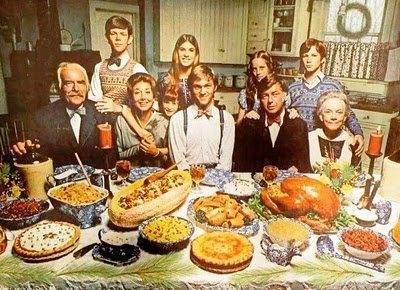
The whole contemptible Walton clan struggling through hard times with another meager meal.

I hate the Waltons.  Not the Walmart Waltons.   I like them.  Save money.  Shop smart.  Only at Walmart. That’s good stuff. I mean the TV Waltons–John, Olivia, John Boy, Jason, Mary Ellen, Jim Bob, Ben, Erin, Elizabeth, Grandpa and Grandma.  All of them.

In real life, I try not to hate people.  It’s just not good.  I have no such reservations with fictional characters.  Aunt Bee, Jenny from Forest Gump, Bruce Dern in The Cowboys, any Jim Carrey character–each of these is vile in its own way and intended to be so.  The Waltons, though, are different. They are supposed to be sympathetic, even likeable, yet I hate them.  Why?

The Depression

The Waltons lived in the Great Depression, except for them it was the Not So Bad Depression.  They had a house.  A sawmill.  A truck. They lived on Walton’s Mountain, which means they had their own freakin’ mountain, for God’s sake.  Ever see their meals? Roast pig, turkey, chicken, vegetables, pies, cakes–you name it.  My Dad grew up in the Great Depression in a house with seven kids.  Mush, that’s what they ate.  Oh, and maybe ham they cured themselves.  The Waltons lived like kings.  I hate that.

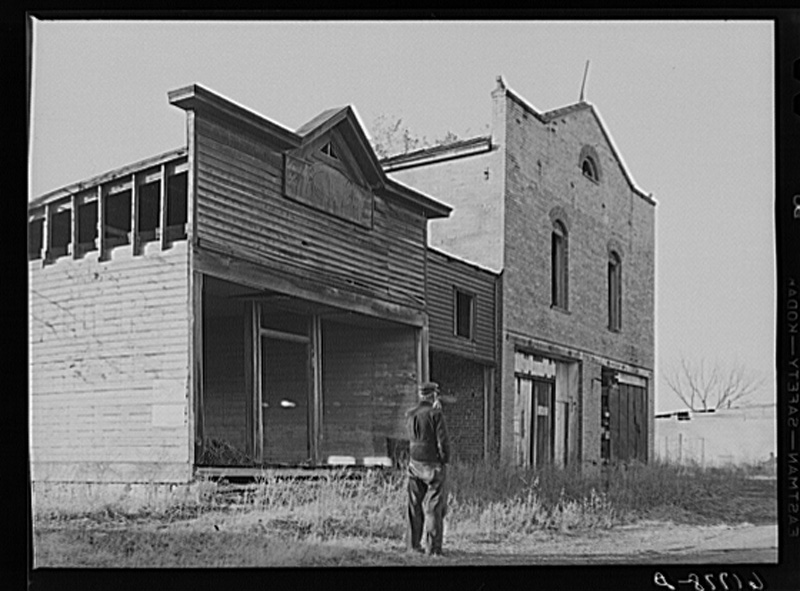
Here’s what a family with seven kids looked like during the Depression.

The Parents

John and Olivia were a lovey-dovey pair right up until Olivia got shipped off to a TB sanitarium in a contract dispute. So solemn, so wise, just like real parents, right?  Here’s how you’d be if you had seven kids with all the drama of that crowd:  John Boy would come in with one of his pressing social issues he was trying to resolve.  John would look at him and say:  “How the hell should I know?”  Or he’d say something like:  “Hey, egghead, how ’bout working at the damn sawmill for a while?”

The Kids

Okay, I know there were seven of them, but there really were only three and a half for all practical purposes.  John Boy, Mary Ellen and Jason. These were the Big Three before anyone ever heard of Kevin Garnett, Ray Allen and Paul Pierce.   The other four just drifted in and out occasionally.  I’m not even sure Erin was really on the show.  She disappeared for long stretches.  I never could keep Jim Bob and Ben straight.  I had to remind myself that Jim Bob delivered his lines like he’d suffered a debilitating head injury.

One would think that the casting folks could have at least tried to find kids who resembled each other to play siblings.  In a modern setting, that bunch would have subject to DNA testing the first time anyone saw them together.

John Boy is my biggest problem.  He’s like one of those people you should like, but you just can’t.  You know the type.  The neighbor who is very friendly, always speaks and will help you with anything.  You want to kick a nail into his ear.  John Boy is like that.  Almost every episode has “Here he goes, again” moment with John Boy.  He’s helping someone or misunderstood or stuck in the middle of some issue.  Lighten up, John Boy.

Earl Hamner wrote The Waltons, and I assume John Boy–being a writer–is modeled after him.  That probably explains why he dominates the Walton landscape.  Here’s a question:   Was Hamner called Earl Boy?  If not, why the hell is John called John Boy?  NO ONE HAS EVER BEEN CALLED THAT!  If you grew up in the ’70’s and shared this name, you were at some point called “John Boy.”  Even today, you will be called that.  I know from whence I speak on this one.  That is reason enough to hate John Boy.

I have to mention Fake John Boy.  At some point in the series, Richard Thomas (John Boy) decided to leave to pursue other acting opportunities in the most ill-conceived career move since Pernell Roberts abandoned the Ponderosa to embark on his storied movie career.  Fake John Boy was worse than the real one.  He wasn’t John Boy.  Oh, he was nauseatingly earnest like the real one, but you couldn’t help but yell “FAKE!” when he was on the screen.  Okay, maybe I’m the only one who did that.

GRANDMA AND GRANDPA

Look, I know generations of families used to live to together.  I guess that was realistic enough.  Man, these two had their noses in everything.  I hated them.

Wil Geer played Grandpa.  He was a hippie and friend of Woody Guthrie, which means I should have liked him, but no, I didn’t.  I think it’s because the writers couldn’t figure him out.  Was he comic relief?  Was he a wise old sage?  Was he just a pain in the ass like some old people?  You never knew for sure.  To some extent, he suffered from a 1970’s phenomenon known as “The Hip Oldster.”  In the ’70’s, TV writers, being largely devoid of original ideas, wrote every older character the same.  They would be hip, oversexed, “cool” people.  They rode motorcycles and said naughty things.  Sometimes, that’s what they did with Grandpa.  Sometimes, he was the voice of reason.  Mostly, he just annoyed me.

Ellen Corby was a little more tolerable as Grandma.  She actually acted liked an old lady.  Surly, hard to deal with, opinionated and not particularly pleasant.  Now that I think about it, I kinda of like her.

The Godseys

Ike Godsey owned the General Store.  Other than a few passing references to “hard times,”  Ike seems to have thrived through the Great Depression and the rationing of World War II.  His store was FULL of stuff.  He was probably the richest man in Virginia by the end of the war.

Cora Beth wouldn’t have been so fired up about “Mr. Godsey” if he’d owned this Depression era store.

He married Cora Beth, an impossibly haughty friend or distant relative of Olivia’s who showed up to sponge off the Waltons’ inexplicable largesse.  Ike decided to marry her.  Even John recognized what a pain in the ass Cora Beth was and tried to talk Ike out of marrying her.  Like a lot of folks, he didn’t listen and married her anyway.  She continued to preen around for years.  Oh, and she always called Ike “Mr. Godsey.”  I hated that.

How about have Erin turn up pregnant and marry Ike in a shotgun wedding?  That would have been a ratings bonanza!  Plus, Erin would have actually played role in the show.  No, we got Cora Beth.  I hated her.

The Pathos

At the heart of The Waltons was some pitiable, sad story with a comparatively uplifting ending, usually because of the superior intelligence or morality of the Waltons themselves.   No family is THAT good, except maybe the Cartwrights.  I cared nothing for it and always wanted the Waltons to get put in their place.  It never happened.  I hated that.

The Ending

Good night, John Boy.  Good night, Mary Ellen.  Good night, Jim Bob.  Blah, blah, blah.  That’s how the show always ended.  Hey, were they all in the same freakin’ room?  That’s weird, especially since they were able to say good night to their grandparents without raising their voices.  I shared a room with two brothers when I was little.  It’s not fun.  Just once–once, mind you–I wanted someone to say:  “Hey, shut the hell up!  I’m trying to sleep!”  No one ever did.  I hated that.

Here’s the kind of house the Waltons would have lived in. I’m guessing they wouldn’t have been quite so chipper at bedtime in this place.

At this point, you’re asking:  “If you hate the Waltons, why do you know so much about them?”  First, that’s really none of your business.  Second, I watched a lot of TV as a kid.  A lot.  I didn’t care what I watched.  I watched the Waltons to just hate them.  Sometimes, my Dad would watch with me and ridicule them.  I liked that.

Occasionally, I’ll see the Waltons on TV and tune in for a few minutes.  It doesn’t take long for me to be disgusted.  I always hope I’ll catch the episode when their house burned.  At least I think that happened.  Maybe that was just my own fantasy.

Good night, John Boy.

©thetrivialtroll.wordpress.com 2012

My Life as a Hippie

This title, of course, is deceiving. I’ve never been a hippie. I was born in 1962, far too late in the century to have become a hippie. I was, however, fascinated by hippies. They seemed cool. They seemed–appropriately enough–hip.

Growing up in Harlan County, Kentucky, there were no hippies or at least there was no real hippie movement. Oh, there were some hippies over in Letcher County–they founded Appalshop. In fact, they’re still there. There was a time when a “busload” of hippies was rumored to be coming to Harlan County to check out our horrible living conditions. Turns out that they were just run of the mill Communists, not really hippies at all.

My older brother knew a guy who was going to become a hippie. Charles was his name. Charles had been in and out of “Reform School,” that shadowy institution that none of us really knew much about it. Charles, however, had actually been there. Charles was quite fond of my brother for some reason. You must understand that my brother was a straight A student and all round good kid. Never got in trouble. For some reason, though, he occasionally attracted “friends” who were sketchy to say the least. Charles would occasionally follow my brother home from school. He’d hang out at the house for a while until my mother fed him. Sometimes, she would even give him a couple of dollars.

Charles once followed us home from school on a rare day when my brother had a bad day at school. He had a dust-up with a teacher over some silly infraction. When we got home, my brother laid out the story to Mom. Mom had no tolerance for injustice doled out to her children and made it clear that she would deal with the situation. Charles sat at our kitchen table and took it all in. When Mom was done, he said: “Don’t you worry, Mrs. Williams. I know a feller in reform school who’s gonna kill that teacher soon as he gets out.” That’s the kind of guy Charles was. Mom just said: “Thank you, Charles.” Secretly, I hoped that guy would get out soon.

One day in the summer, I was walking home from Russell’s Grocery, when–much to my surprise–Charles stepped out from behind a tree. He was probably 15 at the time. His hair was shaved down to a close crew cut. He wore mirror sunglasses, a buck skin vest (no shirt) and love beads. “Do you know me?” “Yes, Charles, I know you.” He explained that he had been released from Reform School. Of course, he followed me home.

Mom talked to Charles about his adventures in Reform School, and he announced that he was going to move to “The City” and become a hippie. I noted that his hair was far too short, but he explained that the Draconian rules of Reform School required that look. I think that’s the last time he was at our house. I don’t think he ever became a hippie, but his ambition gave me a new-found respect for him.

Back to the real hippies. During the Summer, we would sometimes travel to Utah to visit my grandparents or to Colorado Springs to visit the Air Force Academy for whom my Dad was a recruiter. On those trips, I saw the real hippies. I saw one in a Stuckey’s somewhere in the West once. I just stared at him. I saw one get arrested on the street in Salt Lake City, too. Very cool.

Once, when we were in Salt Lake, President Nixon came to speak at Temple Square. My Papaw was a security guard at Temple Square and stood on the stage with Nixon. This was probably 1969. The hippies were out in force. War protesters carrying signs–the whole nine yards. My Dad put me on his shoulders so I could see Papaw, but really I was checking out the hippies.

Somewhere in this sea of humanity are my Papaw and Richard Nixon…and a bunch of hippies.

The only person I ever saw in Harlan County that I thought was a hippie was the son-in-law of the people who lived across the street from us. He had long hair and a beard and wore hippie clothes. My little brother and I would peek out the front window of the house just to get a look at him. I knew he was a hippie, because my Dad said so.

At this point, I should confess that I didn’t really want to be a hippie. First, hippies were draft-dodgers and war protesters, which was really frowned upon in our home. Second, let’s face facts here–hippies were dirty, and I’ve never enjoyed being dirty. Third, they were dope fiends, and I was never into the drug scene. Nevertheless, they fascinated me.

I did have some love beads. My Mom bought them from some Indian kids when we drove through an Arizona reservation one time. I wore them proudly, although I’m sure they clashed with my otherwise cherubic appearance.

I wouldn’t have been a good hippie. Oh, sure, I would have loved the lack of responsibility and free love aspect. I hated school with a passion, so “dropping out” would have been right in my wheel house. Communal living, on the other hand, has never been my “bag”–as a hippie might say. I don’t like sharing my sleeping quarters with family, much less strangers. The being filthy would have been a drag (another hippie word!). Plus, I’m a bit of a germaphobe, and most hippies looked slap eat up with germs.

Typical hippie filthiness. There’s not enough hand sanitizer on Earth to get me in the middle of all that.

Hippies were also liberals. I’m talking real liberals, not the kind people talk about today. For example, a hippie wouldn’t take a political donation from a corporation. Of course, this assumes that a hippie would run for office which he or she certainly would not. They believed in real collective living–everyone living together and lying around in a big pile. I guess the word “Communism” comes from “commune,” and hippies loved communes. Like true Socialists, hippies would have seized the means of production if working weren’t so antithetical to the hippie credo. Now, I never was all that liberal and certainly didn’t live in a liberal culture. As I’ve noted, free love would have been cool or even groovy, but eventually the hippies and I would have clashed over something like the capital gains tax.

When they drove, hippies drove vans. I don’t even like mini-vans. Regular vans are certainly out of the question. Nowadays, full size vans are the typical mode of conveyance of serial killers. I prefer BMWs–definitely not a hippie ride.

Typical hippie van. I prefer my metallic gray BMW 328. I won’t even put a bumper sticker on my car.

I would have been good at sounding like a hippie. I’ve had an annoying habit of using the word “man” most of my life, as in “What’s up, man?” “Man” was very much a hippie word. So was “dude,” although it’s made quite the comeback in recent years. I always wanted to use the word “groovy,” too. Maybe I could bill myself as “The Groovy Lawyer.” “Cool,” of course, was a staple of the hippie lexicon, borrowed from the Beatniks. I still use “cool” in everyday conversation.

I also liked hippie music. The Beatles were liked by hippies, and I like the Beatles. Same goes for Jimi Hendrix, The Doors, Led Zeppelin and countless others. Hell, I heard a recording of Charles Manson singing once, and he wasn’t half bad for a psychotic, murdering hippie. Say what you will about hippies, they dug some cool music.

So, I didn’t become a hippie, and I really had no chance to do so. That’s probably good, because you eventually become an old hippie. Worse, you become a former hippie and end up kowtowing to The Man like the rest of us, unless you become The Man.

Example of the tragic outcome of the old hippie. Nothing groovy about this.

In Maui a few years ago, I met a guy who said he moved there in 1969 to live in a commune. He never left. He didn’t look much like a hippie. So, I asked him what he did now, forty years later. He said he worked in construction, but added: “I’ll always be a hippie, man.” What could I say? “That’s cool, man.” It was a groovy exchange.

Still yet, I have admiration for the hippies. I know many folks–now conservative pillars of society–who proudly declare that they are former hippies. I also know people who still claim to be hippies, although that’s doubtful. Being a hippie now is like claiming to be an anarchist. Maybe you are, but the glory days passed long ago.

So, if you’re an old hippie, I salute you. Now, get a haircut and take a bath.

©thetrivialtroll.wordpress.com 2012

Festival of the Poke

Poke in its natural state.

It’s that time of year in Harlan County, Kentucky. Time for the Poke Sallet Festival. It’s been many years since I attended the Festival, but I have many memories of it.

“What is poke?” you ask. It’s a weed. It grows out in the woods. It doesn’t look like anything you’d eat. It also doesn’t taste like anything you’d eat. Legend has it that folks would go into the woods, pick it and put it in bags. Bags of course were–and still are–called “pokes.” You cook it down–often boiled–and slop it onto a plate. A green onion and cornbread usually completes the presentation.

The foul weed prepared for eating.

I’ll admit that I’ve only eaten poke a couple of times. It’s foul. It smells bad when it cooks and on your plate. I think it is served with an onion to give the diner something to kill the taste. It’s kinda like kale, only more pungent and weedier tasting. Like all greens, it also has a violent laxative effect when eaten in large quantities.

I don’t know what in the world “sallet” is, except a mispronounced word.  Sallet isn’t any easier to say than “salad,” but I guess that doesn’t matter, does it?  Besides, poke isn’t eaten in a salad, as far as I know.  It’s just cooked down into a slimy, nauseating mess.

Why am I writing about poke? Because I enjoyed the Festival when I was a kid. For several years, my father was the chairman of the Poke Sallet Festival. I was a little kid, and that impressed me. Dad seemed like a big deal. I liked that.

I don’t know why Harlan County chooses to honor poke. Seems like every Kentucky county has a festival for something. I guess Harlan wanted something, too. Coal was probably too obvious a choice.  We don’t have much else.

There are a lot of things from childhood that I don’t remember well. But I remember the Poke Sallet Festival.  What do I remember?

Gladys Hoskins: She was the long time boss of the Harlan Chamber of Commerce and lived across the street from us. I don’t know if she was Chairperson or President or what, but she was the boss. She and Dad worked every year to bring it all together. I can still see Mrs. Hoskins smoking a cigarette and–always–dressed to the nines.

Stone Mountain Park: It might have been Stone Creek, but it’s where the Festival was held when I was a kid. It was somewhere up around Smith. It was a couple of shelters but pretty nice–or I thought so. Eventually, things moved to downtown Harlan which makes more sense. Plus, there’s slightly less chance of getting killed in town.

The Red, White and Blue Band: There was always music at the festival. One year, The RWBB played. Never heard of them? They were, as Dad said, “a bunch of hippies.” It was the late 1960’s/1970’s early and that’s what they were, I guess. Actually, they were from Clover Fork in Harlan County. The lead singer was Merle English, one of my Mom’s students at Evarts High School.  Someone told me they played Acid Rock. An old man said they looked like “dope fiends.”  I loved them. I’m pretty sure no one else did. As you might imagine, the bands were usually country or bluegrass.  Years later, English became Max English and a successful lounge singer.  True story.

Jimmy Skidmore: Jimmy liked to dance. He danced to whatever the band played. He could dance the hell out of any song. No partner required. He was a nice guy and had a helluva good time. I’m sure today’s more politically correct world would frown on this. That’s a shame. He had fun and everyone enjoyed it.

Alfred: I don’t his last name, but he could sing. He also didn’t have front teeth, leaving him with prominent fang-like canines. But, like I said, he could sing. He would usually sing Six Days on the Road or Okie From Muskogee.He would belt them out. Good stuff.

The Governor: Governors Louie Nunn and Wendell Ford would come to the festival. Ford was great. He would eat poke, shake hands and pose for pictures with everybody. Nunn was good, too. One time they presented Nunn with a portrait painted by a local artist. It was pretty good, but for some reason Louie’s face was painted with a scowl. When it was unveiled, his reaction was roughly the same look. Even as a small child, I knew it was funny. Dad laughed himself silly.

Steve Lyon: He was Mrs. Hoskins’s son-in-law. He was a hippie–or at least I thought he was. He had LONG hair and a beard. In case you haven’t noticed, I was a bit fascinated by hippies. By “a bit,” I mean a lot. We didn’t have hippies in Harlan, but I’d seen them when we went on vacation. Steve was definitely a hippie. Anyway, he was also a musician. A pretty good one, too. He played at the Festival one year. He played the electric organ and sang a song about throwing his mother down the stairs. Even my Dad was impressed. Much like the Red, White and Blue Band, he wasn’t the audience’s idea of entertainment, but he was good.

Virgil Q. Wacks:  Virgil Q came to the Festival to film highlights for his weekly show Virgil Q. Wacks Variety Time. His show was part advertising, part travelogue.  He filmed around Eastern Kentucky, Southwest Virginia and East Tennessee.  He used an old-fashioned, windup camera with no sound.  He would narrate the film on his show.  His trademark was the extreme close up where he would zoom in on his subject until the picture blurred out. He would also refer to most people as “smiling” and “genial,” regardless of how unfriendly or even dangerous looking his subject was. Virgil Q always excited the crowd, because you knew you might be on television.  It’s hard to describe Virgil Q’s show, but we loved it. Any time I hear the old song Happy Days Are Here Again, I think of Virgil Q.  By the way, I don’t hear that song all that often.

The Melting Pot:  The Festival was a true Harlan County melting pot.  People from all over the county came to it:  Loyall, Harlan, Wallins, Evarts, Cumberland, Benham, Lynch, Chevrolet, Cawood, Cranks, Smith, Punkin Center, Ages, Verda, Lejunior, Lenarue, Catrons Creek, Pathfork, River Ridge, Holmes Mill, Baxter, Keith–every town, community, camp and holler was represented.  Harlan County is sparsely populated but 50 miles wide.  You can live your whole life in the county and never see some parts of it.  The Festival was where everyone gathered.

It’s been over 20 years since I’ve been to the Festival.  By then, it was already firmly established in downtown Harlan. The poke dinners were served at Jay’s Restaurant.  I took a friend of mine with me.  He was running for some office and wanted to go to Harlan to meet people.  This was during the last gasps of the United Mine Workers Union in Harlan, and the UMW was out in force.  A lot of union folks were dressed in camouflage and fatigues like some militia.  My most notable encounter was with local character and raconteur, Rubber Duck.  I introduced him to my friend, whereupon The Duck said:  “Buddy, can you believe  I got run over by truck?”  My friend looked at The Duck’s scarred up face and said:  “Well, yeah…I can believe it.”  The Duck responded:  “It takes more than a truck to kill The Duck!”  That’s about all I remember, but, man oh man, did that make me laugh.

Back to the poke.  I don’t recommend it.  I think it’s something people ate back when there wasn’t much food.  You’d find something growing and eat it.  If it didn’t kill you, it was food.  My Dad said he used to eat mush, which he described as “not fit to eat, but that’s all we had.”  Poke is like that.  Now, I know people who eat poke and claim to like it.  Maybe they do.  I’ve known people who ate souse and other vile foods and claimed to like them, too.

I’m sure poke has all sorts of nutritional value–antioxidants and whatnot.  I’ve heard people say that it can cure various ailments.  That may well be true.  If you say it is, I really have neither the knowledge nor the energy to argue with you about it.  I still don’t like it.  Nevertheless, it makes for a helluva festival.  Corbin, Kentucky has a Nibroc Festival, which is just “Corbin” spelled backwards.  I guess Harlan could have the Nalrah Festival, but that sounds like some Middle Eastern deal.  Poke it is and should forever remain.

Based on the photos I see of the modern Poke Sallet Festival, it doesn’t resemble the one of my youth.  There are bands with real stages and sound equipment.  Sometimes, all we had was a guy with a banjo.  Honestly, it’s probably much more entertaining now.  Plus, you don’t have to drive all the way out to Smith.  It looks like there are multiple venues for entertainment, too.  Of course, there’s still the poke, but I bet you can get lots of other stuff to eat now, too.  Progress is a good thing.

There a lot of things I don’t remember about my childhood–birthdays, school events, holidays.  I remember a lot about the Poke Sallet Festival, so it must have been pretty good–all except the poke part, I guess.

©thetrivialtroll.wordpress.com 2012

Colonel Earl

“Why do men fight?” In his old age, my Dad would often ask that somewhat rhetorical question. I knew not to answer. He would answer it, explaining that men fight because they’re trained to fight–no other reason. I always saw the military through my Dad’s prism. He was a veteran of two branches of the military and two wars. He was as proud as one could be of his service. I was born in 1962, perfect timing to avoid military service. The draft was suspended before I was 18, and there were no wars while I was a young man. Besides, Dad told me that I wasn’t military material anyway.  He was right.

Almost everything Dad told me about his service was in the last 5 years of his life. Prior to then, I’d heard a few stories, like the time he debriefed a couple of pilots who spotted UFOs over China.  He also told a few stories about the time he spent in the hospital in WWII. Otherwise, like a lot of men of his generation, he didn’t talk all that much about it.

In January of 2003, Dad had a stroke while at a meeting. He passed out, but came to almost immediately. Because he seemed disoriented, a friend of his called me and said “Earl had some kind of spell. You better check on him.” I called Dad, and he seemed fine but very tired. I made him promise to see the doctor in the morning.  I talked to Mom, too, and she said he seemed okay.

Turns out that Dad had a major stroke that night. Oddly, he had no severe physical effects from it, but it did affect his mind. At first, I couldn’t tell any difference, but one day shortly after the stroke, my mother called and said I needed to make the 3 hour drive to Harlan to see them.  It was, she said, “a crisis.”

My mother was given to hyperbole, and I assumed this was more of the same. She had fallen about a week before Dad’s “spell” and was still pretty sore. I was talking to them both daily, and he seemed fine to me.  Nevertheless, I headed down there.

When I got there, Mom was on the couch and Dad was in his usual spot in the kitchen. I sat down with him and asked if he was okay. He said: “Did I ever tell about Korea?” He then drew a map of Korea and told me about it. In detail. He drew the map from memory, and it was remarkably accurate.  After about an hour and half of listening, I told Mom:  “Okay.  You’re right.  Something is wrong.”  After a few doctor’s visits, we found out he had a significant stroke.  As with a lot of my Dad’s ailments, he was an unusual patient.  His doctor at the University of Kentucky told me that out of the thousands of stroke patients they see each year, they get 3 or 4 like him–those who suffer severe strokes without physical damage.  The good news was that the doctor told me he would have these spells of “delirium” where he would talk and talk, but that it would get better.  It did.  In the meantime, I learned a lot I had never known.

Oh, and my mother was right.  It was a crisis.  Her fall led to a series of issues for her, and she was dead by May.  Dad was alone now, and we had much more time to talk than ever before.  He wore me out.  As with a lot of things, what at first was maddening turned out to be a blessing.  For the next five years, I got to know him in a way that I never had up until then.

Dad was born on January 19, 1925 in Evarts, Kentucky, the fifth of seven children.  He had four older sisters–Emma, Pauline, Mabel and Mildred–and two younger brothers–Jack and Paul.  His father, Walker, was a coal miner and later ran a gas station.  Dad grew up poor.  He said “You know how people say they were poor and didn’t know it?  WE knew it.”

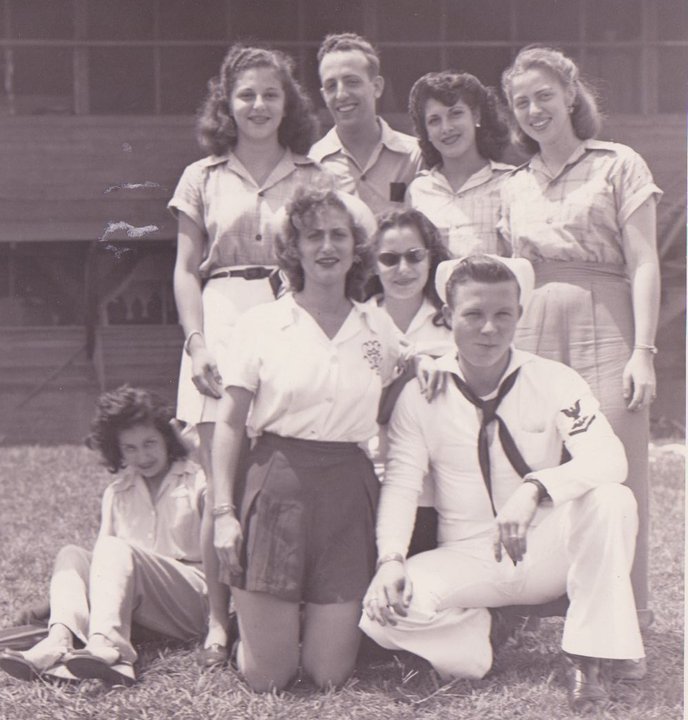
Dad joined the Navy in late 1942. He turned 18 on January 19, 1943. He didn’t finish his senior year at Evarts High School, but he graduated anyway. They would do that for you in those days. My Granny accepted his diploma. He was 5′ 5″ and weighed 115 pounds.

1943. Dad at the Great Lakes Naval Station.

Dad went to the Great Lakes Naval Station in Illinois. The last time I spent the night at Dad’s house, he said to me–completely out of the blue–“Did I ever tell you about playing the bugle?” No, he hadn’t.  Here’s what he said, almost word for word:

“When we got to Great Lakes, they asked if anyone could play the trumpet. Of course, you know I was an outstanding trumpeter. I said I could, and the Petty Officer said ‘You play Taps at lights out.’  Well, buddy, I knew I could do that. So, I played Taps at lights out every night. Then, I’d go to my bunk, square away my bugle and listen to everyone cry themselves to sleep. Every night. We were all children, and we all wanted was to go home.  How ’bout that?”

Dad saw no action in the Navy. He did get in a plane crash in Florida.  The transport plane took off without refueling and came down right after take off.  Dad was unhurt, but he saw one man decapitated.  When he got to Panama, he got sick. Very sick. I’m not sure what he caught, but he always said it was either malaria or black fever or both. He also got jungle rot, which ate up his feet. That pretty much ended his chances of seeing action in the Pacific. When he was in the hospital, nurses used to bring people to see him to show how young he was. As Dad liked to say, “I was a just a little fella.”

Dad living it up with some nurses in the Navy.

The Navy ended up training Dad to be an airship rigger. That’s right, airships–blimps. Dad noted many times that he couldn’t have been trained in a more useless vocation, although Goodyear did offer him a job. By 1946, Dad was out of the Navy.  With the future of airships not looking promising, he had to do something with his life.

Dad never hesitated to credit the GI Bill for his success in life. All he’d ever aspired to was a “good job outside.” By that, he meant at the coal mines but outside, not underground. Instead, he got to go to college. He went to the University of Kentucky and immediately signed up for Air Force ROTC.

Dad had enjoyed the military life but didn’t like being an enlisted man. He wanted to be an officer, and college gave the chance to do that. He graduated with a degree in geography and as a Lieutenant in the Air Force. He wasn’t a pilot. He trained to be an intelligence officer. He didn’t think there would be another war as soon as Korea, and he didn’t think the pilots would have much to do during peace time.

Well, Dad ended up in Korea, where he was an intelligence officer. He was attached to the 51st Fighter-Interceptor Wing of the 5th Air Force.  He oversaw spy missions.  When the war ended, he came home aboard a morgue ship. It was the only ship heading out, and he took a ride along with 1500 dead soldiers.  “It was a quiet voyage,” as he liked to say.

Dad sailing home from Korea, the epitome of cool. I have that scarf.

Dad returned to Evarts.  He had met my mother just before leaving for Korea–she was a school teacher at Evarts High School.  They married in 1957 and had three children.  Me, my older brother Tom and younger brother Richard.  Richard died in 1987 at 20 years old.  Dad weathered that like he did everything else.

Dad went on to serve 30 more years in the Reserves. Most of his service was as a Liaison Officer for the Air Force Academy. He recruited potential cadets for the Academy. He loved every minute of it.  We also got to visit the Air Force Academy quite a few times.

Dad had a variety of jobs, including Health Department Inspector and field agent for the old Kentucky Water Pollution Control Commission.  His greatest success was as one of the first environmental consultants for coal companies.  Nothing, however, topped his military experiences.

With all his military service, one would think Dad was a super-patriot. Not really. He was always proud of the military and his own service, but he had a very cynical view of wars and those who start them. He did not believe that there were war “heroes.” He told me that there were two types of “heroes”: One was a person caught in a dangerous situation who just did what he was trained to do. The other was a crazy man who just didn’t care. Dad’s view never wavered. Soldiers do what they are trained to do. Period.

Here’s an example of Dad’s view.  He served in Korea with a pilot about whom a movie was made. What Dad remembered about him was having to tell the pilot that he would be court-martialed if he got arrested again. As Dad said, “He wasn’t a hero. He was crazy.”

Here are some of the things Dad drove home to me, over and over:

  • Soldiers aren’t driven by patriotism. That might be why they are in the military, but it’s not what drives them. Discipline and training are their motivators. You are trained to follow orders, and that’s what you do.
  • No one wants to die for their country. They’ll do it, but not because they want to do it. Everyone he knew wanted someone else to die for their country. He met a lot of injured in the hospital. He said not a one of them thought it was worth it.
  • World War II was a miserable experience for almost everyone involved.
  • Nothing–nothing–got his back up more than politicians talking about soldiers “defending freedom.” Dad’s view was that wars may be about freedom–but maybe not. They’re about whatever a politician decides is worth it.
  • He despised George Patton. He said Patton was a “glory hound.” Dad told me that when he was in the Navy, he “heard about Patton slapping that boy in the hospital,” alluding to the famous story of Patton slapping a shell-shocked soldier. “Slapping was too good for that SOB. They should have shot him.” I said something like: “Geez, Dad, the poor guy was in the hospital.” Dad: “I’m not talking about him. I’m talking about Patton!”
  • He also wasn’t impressed with General MacArthur, either.  “A soldier who can’t follow orders isn’t a soldier.”
  • Never, never underestimate the importance of the GI Bill.  Without it, he never goes to college, and we all end up suffering as a result.

You’d be wrong to think my Dad didn’t love his country or the military. He did, warts and all, but he taught me to never overlook the warts.

He drew me maps of Korea and showed me where they flew spy missions.  He told me detailed stories right down to the names of those involved and even dates.  His stroke had scrambled up his recent memory.  He could remember most things, but he got the timing of things out of order.  His military career, though, stayed sharp.

Without intending to do so, Dad learned to compensate for his memory problems.  He kept notes.  He had a billing paying system that required him to keep every bill and envelope, but it worked.  He kept track of his medication on a legal pad that he kept with him at all times.

I also found out some less serious things.  When he was at Great Lakes, he used to like to visit the “Old Sailor’s Home.”  He said:  “I would sit and listen to the old salts tell their tales of the days of wooden ships and iron men.”  Wooden ships and iron men.  That had always been a favorite expression of Dad’s.  I never knew that he heard it at the Old Sailor’s Home.  He told me many times that, if he couldn’t take care of himself, to just send him to the Old Sailor’s Home.  Of course, he didn’t really mean that.  The one time my brother and I talked to him about “assisted” living, he responded with “I will die in this house!” (Which he almost did, by the way).  That was the end of that.

What Dad enjoyed most was being Colonel Earl, as a lot of folks in Harlan County called him.  He would have been General Earl, but he wouldn’t attend War College because he didn’t want to be away from us to do it.  He loved attending events where he could wear his uniform.  When I was a kid, we would visit the Air Force Academy in the summer.  I would love those times when someone would salute him.  Very cool.

Lest you think he was a hard-core military father, he wasn’t.  He wasn’t The Great Santini.  He was a kind, doting father who probably should have been much tougher on me than he was.  He had expectations of us, but no one ever praised our accomplishments more.  He could make any trivial success seem like the greatest thing in the world.   One of his favorite expressions was to say that one had a place at “the roundtable.”  This meant you had arrived.  He was always telling me that I was at the roundtable, even when I didn’t feel like I was even in the room.

In 2005, my brother convinced Dad to visit San Francisco, where my nephew lived.  I’ll admit that I was not in favor of this.  I could imagine Dad getting lost in an airport or just being generally difficult taken out of his element.  This is a guy who couldn’t stand to spend a single night away from his home.  As usual, I was dead wrong.

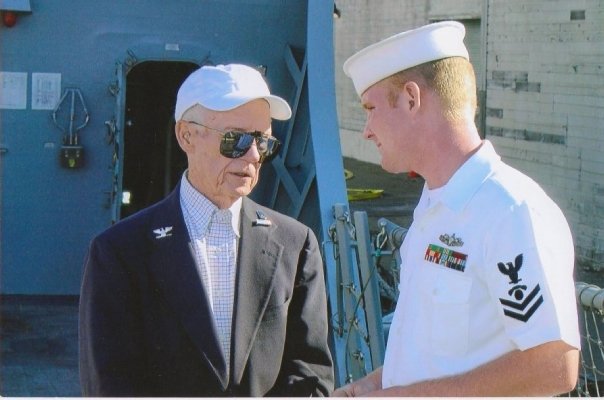
Dad toured the USS Hopper that week during Fleet Week.  Because he was a retired officer, the ship’s bell rang when he boarded and he was treated like a celebrity.  He absolutely loved every second of it.  He also had dinner at the Top of the Mark restaurant where he ate in 1953 when he returned home.

Dad aboard the USS Hopper in 2005, no doubt telling this young man of the days of “wooden ships and iron men.”

Few people knew how bad Dad’s health was the last few years of his life.  We would visit his cardiologist, and the doctor would be amazed that Dad could walk up steps or even breath unaided.  The day before he died, Dad and I talked. He was in bad, bad shape and lucid for only brief periods.  He said:  “I think I might have a death rattle going on now.  I’m not scared.  I’ve lived a life mortal men only dream about.  Don’t you go moping around about your poor old daddy.  This is how this is supposed to go.”  He died the next day.  I spoke to him on the phone only minutes before he died.  The last thing he said:  “I feel fine.”  You know what?  I think he did.

Dad’s last big military honor was his funeral in May of 2008.  The Air Force Honor Guard from Wright Patterson Air Force Base served as pallbearers.  A bagpipe played Amazing Grace.  The Harlan County Honor Guard was there, too.  One of the men presented me with a Bible.  He leaned over and whispered:  “Your daddy was a good buddy to all of us.”  At the end, a bugler–unseen, mind you–played Taps just as three jets flew over Resthaven Cemetery.  I thought about that little fella from Evarts playing Taps at Great Lakes.  Mostly what I thought was that Dad would have LOVED it.

©thetrivialtroll.wordpress.com 2012

The Gaiety of Marriage

I’ve been married for 24 years to a woman.  Wow.  Congratulations to me.  It’s pretty surprising to think that someone married me.  More surprising is that I don’t recall anyone asking me about my views of marriage until recently. Oddly, though, it’s never about my marriage or how I could convince someone to marry me or stay married to me for so long.  No, people want to know what I think about gay people marrying.  I’m not gay, so I’m not really an expert on that.  So be it.

Several folks have asked me about my views of gay marriage.  Now, I’m a fairly conservative sort, and I expect that my response is supposed to be some form of outrage.  Instead, I say:  “I don’t care.  People can marry whomever they want.  It doesn’t affect me.”  Then, I’m likely to be lectured on the Bible, societal collapse and sundry other topics of limited interest to me.    The gist of the response is “HOW CAN YOU SAY THAT??”

Here’s how:  It’s not that big a deal to me personally, but it is to the folks who would like their relationships legally recognized.  When I say I’ve been married 24 years, no one really cares all that much.  Oh, they’ll congratulate me and say “that’s great” or some other lukewarm response.  But, the truth is it’s really only important to me–and my wife (I hope).

If your hands are now poised over the keyboard to explain the Bible to me, stop.  I’ve read the Bible, and I know that it doesn’t speak highly of homosexual relationships.  Speaks poorly of tattoos, too.  And women.  It also says that I should stone my kids to death if they are disrespectful.  Maybe I’ll do that one day.  In the meantime, I’m not one who thinks we should build our laws around the Bible.  Just like the more radical Muslim countries adopt Sharia law, some would have us do the same.  Not me.  By the way, traditional Islam condemns homosexuality, too, so there may be some common ground there with our Muslim brothers.

If you want to belong to a church that won’t ordain a gay marriage, go ahead.  Again, I don’t care.  That’s your business. Now, if YOU are gay and want to get married in a church, I’d suggest changing churches, but again that’s not my business.  Just don’t expect an entire denomination to change its ways to suit you.

That’s church, not the government.  Those are two separate entities, as they are constitutionally required to be.  Our government, which is supposed to provide equal protection under the law, isn’t a church.  The government can–and should in some instances–recognize rights where a church may not.   Some churches don’t approve of dancing.  Yes, that’s right–dancing.  That doesn’t mean we outlaw dancing.  Same goes for drinking and gambling.  Serious vices when taken to extremes, to be sure, but down right Hell fire sinful even in moderation to some folks.  Hey, don’t do it if it’s sinful to you.  If you think a man marrying a man is sinful, then don’t marry a man, unless of course you’re a woman.

What about the collapse of society?  Here’s a secret I’ll share with you:  There have always been homosexuals.  Always.  Society has not yet been crushed under the weight of this fact.  I grew up in just about as conservative an area as one could.  We had gay people.  We knew who they were.  Some were prominent people in our county.  It didn’t seem to affect anyone.

What about destroying marriage and the family?  PUH-LEASE!  I know a guy who’s been married three times who told me that gay marriage would destroy marriage.  Maybe a dude married and divorced that many times is destroying it.  He sure helped destroy three marriages.  I’m not sure how this is supposed to happen.  Will hoards of gay couples come to our house and convince us that we shouldn’t be married?  In my case, I figure if two DUDES can be married surely my beautiful wife and I can handle it.  Maybe we’re supposed to be tempted to marry someone of the same sex if it’s legal.  I pretty comfortable that I won’t do that.

But, what of the Gay Agenda, you say?  I used to know a guy who often spoke of the Gay Agenda.  He never really explained it to me, but from what I could gather it was some type of conspiracy to turn us all gay.  I think I can resist, especially since I’ve known a lot of gay people who people tried to make straight.  That didn’t work either.  Plus, I’ve always been attracted to women.  That’s not because someone made a persuasive argument to me about it or because I weighed the pros and cons of it.  It’s just kinda the way it is.

There are some things the law will allow that churches frown upon and vice versa.  In some states, you can marry your first cousin.  Some churches allow polygamy.    (Polygamy, of course, is a sign of madness since it’s always the men taking more than one wife, but that’s for another post).

One thing that seems to be lost on everyone is that just because the President or Vice-President or former Vice-President say they think gay marriage is okay doesn’t make it legal.  As matters now stand, each state can make its own laws and many have banned it.  Perhaps they’ll ban divorce one day, too.  Some churches do.

If you are genuinely tormented by the prospect of gay people marrying each other, relax. It’s likely that half of them will get divorced if they’re anything like their hetero counterparts.  Hell, they may be no better at it than we are.  If you really don’t like gay folks, think about this:  Half of them will end up divorced, fighting in court over alimony and child support.  That’ll teach them.

I’m not suggesting that you turn gay or that you attend a gay wedding.  I’m not even suggesting that you like gay people. Personally, the vast majority of crap I’ve taken in my life has been from straight people.  Gay people can’t be any worse.  The gay people I know are like the rest of us.  Some are alright.  Some aren’t.

We’re Americans.  We’re free to disapprove of everyone.  You’re entitled to think what you think and believe what you believe.  Just think about giving everyone else a break.

©thetrivialtroll.wordpress.com 2012
Love and the Color TV

Your author pictured in the middle being forced to watch black and white TV. I can’t even look directly at it. December 1962.

“This is the happiest day of my life.”  Thus I spoke one day in 1967.  I was 4 years old and talking to a television salesman.  Why was I so happy?  My family had just purchased its first color television.  Color TV, my friends.  It was that simple.  I had seen Batman and Get Smart with their tantalizing “In Color” graphics at the bottom.  Until that day, I could only dream of what that really meant.  Lost in Space, too was in color, as were many other TV shows.  Even at 4 years old, I knew that a life-changing event was unfolding.

My first color TV. No, it wasn’t crooked. That’s the photo–I think.

I think the TV was an RCA.  Could have been a Philco or Zenith.  Of course, it had a round screen.  No remote control, either.  The only remote control I had ever seen was on an episode of Dennis the Menace.  It was roughly the size of a brick.  No, our new TV had a dial.  That was okay, because I liked to sit so close to it that I could just reach up and turn the channels as needed.  My mother told me that sitting close to the TV would cause me to die of radiation poisoning, but I was willing to risk it.  (As a side note, she said standing beside the TV would give one a mega-dose of deadly radiation waves.  I never bothered to find out if any of that was true. After all, you couldn’t see the screen).

TVs used to be complex.  They were called TV “sets,” for some reason.  If you removed the back, the cabinet was full of vacuum tubes of every size imaginable.  Those tubes held all the magic, especially the big one–the picture tube.  I was never allowed behind the TV.  My mother made it clear that to venture to the back of the TV was almost sure to result in sudden and fatal electrocution injuries.  I did, however, have occasion to watch the TV repairman work on it.

Oh, yes, there were TV repairmen.  They would come to your house and work on the TV.  They carried large cases full of vacuum tubes.  Once, I mistook the Jewel Tea Man for Mr. Simms, the TV repairman.  I furiously castigated him for being so late to fix the TV.  I think I was 6 years old at the time.  I was serious about the TV.

TVs used to be full of these. They held all the magic.

Remember vertical and horizontal “hold” dials?  If you do, you’re as old as I am.  For the uniformed, these were tuning knobs you could use to adjust the picture if the screen image began rolling or zig zagging. “DON’T TOUCH THOSE DIALS.”  If you messed up the picture, you might never get it right again.

TV was dangerous in those days, too.  If you broke the picture tube, the TV would explode, killing everyone in the house.  “DON’T HIT THE SCREEN WITH ANYTHING.”  There was the poor boy who–for reasons that remained obscure–kissed the screen and died immediately.  My mom never said whether he was related to the boy who died under similar circumstances kissing a toaster, but it seems likely.  Perhaps my unbridled love of the TV made mom concerned that I would get carried away with passion.  At least I understood the toaster story, given that I liked to stare at my reflection in it like a small Narcissus.

TV stations used to go off the air at midnight, some at 11:30.  They’d usually sign off with The Star Spangled Banner.  You’d just have white noise or maybe a test pattern until 6:00 a.m.

Black and White Test Pattern. What this was supposed to test or why it had an Indian on it are beyond me.

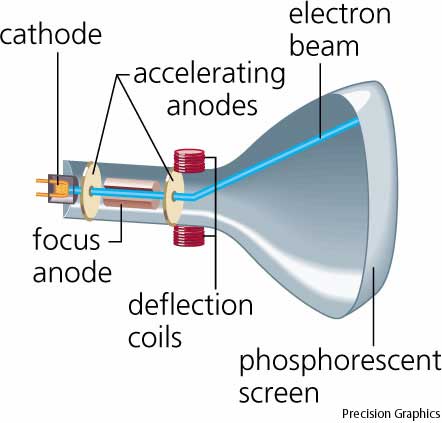
I don’t know the purpose of the test pattern, but someone used it to test something every night.  The old TVs were powered by the magic of the cathode ray:

Diagram showing the basic set up of a TV picture tube.

To this day, I don’t understand any of this.  To me, here is how it works:

Your author’s basic understanding of television technology.

We all know the power of television.  Dress up any troglodyte and put him on TV enough, and–PRESTO!–he’ll be elected to public office.  Have you ever been on TV?  Doesn’t it make you feel like you’re just a little better person than you were before?  People will say:  “Hey!  I saw you on TV!”  You could be on TV eating a live squirrel and people would still think:  “Hmmm.  There’s something different about him, now.”  The first time I was on TV, I was probably 8 years old.  It was the Harlan County Poke Sallet Festival Parade.  My brother and I were riding in a convertible.  I think it was John L. Belcher’s car.  If not, it should have been.  It was the kind of car John L would have driven.

Virgil Q. Wacks filmed the parade for his TV show, Virgil Q. Wacks Variety Time.  If you’re not familiar with Virgil Q, I can’t describe his show.  It was a kind of an advertising/travelogue program.  He filmed us in the car and there we were–on TV.  His film collection is archived at East Tennessee State University where we live forever.

There were many disadvantages to growing up in Harlan County, Kentucky, but TV wasn’t one of them.  We had cable.  That’s right–cable TV in the 1960’s  It was the only way to get a TV signal in the mountains.  (As a side note, I am the owner of 1 share of Harlan Community Television, Inc., the longtime local cable company).  In those days, TV channels ranged from 2 through 13, with the little understood UHF channel to boot.  We had signals on all the channels on the dial:  Lexington, Kingsport, Knoxville,  Asheville.  We might have been Ground Zero in the War on Poverty, but by God we won the TV War before it even started.

I loved that color TV.  Eventually, the dial (or channel changer, as I called it)  fell off.  As most families did, we replaced it with a pair of pliers until it could be located, a minor inconvenience.  Sometimes, I would lie on my back and watch the TV upside down just for the hell of it.

I spent many hours in front of that TV. Yes, Batman was in color.  Spectacular color, too.  By the end of the ’60’s, everything was in color! When I was around 8, I started watching sports on that TV.  Hey, kids:  There used to be one Major League Baseball game a week on TV.  It was called, fittingly enough, The Game of the Week.  It came 0n Saturdays, and I always watched.  There was also an NBA Game of the Week.  My earliest sports memory is Wilt Chamberlain and the Lakers vs. Lew Alcindor and the Bucks.   You rarely saw some athletes at all.  The only time you’d see some players would All-Star games or playoffs.  The NFL, being ahead of its time, always had a couple of games on Sundays.

I am part of the TV Generation.  I knew the TV schedule every night of the week.  When I was 3 years old, I surprised my parents by counting to 100 one night.  When my mother asked where I learned that, I could only reply:  “From the TV.”  I was told–and still am–that TV will rot my brain.  Perhaps it has.  I know the lyrics to the theme for Gilligan’s Island, yet I will sometimes forget my children’s birth dates.

One of the calling cards of the intellectual is the refrain that “I don’t watch television.”  I’m not an intellectual, and I do watch TV.  Always have, always will.  I watch sports on TV.  I watch movies on TV.  I watch sitcoms and true crime and reality shows.  I’ll watch anything for a few minutes.  I’ll watch Toddlers & Tiaras just to get outraged.  I’ll watch shows about 900 pound people.  I’ll watch reruns of King of Queens just to marvel at how it could have been on the air for years.  It’s as funny as a truck load of dead babies, but I’ll watch it.  I’ll watch the news, the weather, the History Channel.  I’ll watch Road House for 500th time.  I may know more about the Beverly Hillbillies than any person alive, and I’m proud of it.  TV series, miniseries, short films, previews, reviews–everything.

That first color TV didn’t stay around all that long.  Within a few years, my father enjoyed some financial success, and we had TVs everywhere.  We even got a remote control Zenith.  We had a TV in our bedroom (technically, it was my brother’s).  We had a TV in the kitchen, too. The old TV was relegated to the basement where we continued to use it, but it was now like an old horse put out to pasture.  Like a horse, it sat in that basement for many years after it quit working entirely.

Now, I have monstrous TVs.  46 inch, 60 inch, plasma, LCD, high def–you name it.  Hundreds and hundreds of channels–all at my finger tips.  I not only have a remote control, I have a pillow which doubles as a universal remote. None of them, though, ever thrilled me like the first one.  I’ve loved them all, but none of them–none–ever made me declare that it was the best day of my life.

One day, there may some disaster which destroys society and forces us to start over.  The first thing I’ll do is try to figure out how to build a TV.  TVs–like ships and airplanes–work on some kind of magic, I’m sure.  So, I don’t where I’d start, but I’d get right on it.

Oh, and it would have to be a color TV.

©thetrivialtroll.wordpress.com 2012

Become a Constitutional Expert

People nowadays love to talk about the “Constitution.”  Of course, I mean the United States Constitution.  Here in Kentucky, we don’t talk much about the state constitution, except when we want to amend it for things like gambling and eliminating the Railroad Commissioner.  The US Constitution is all the rage, though.  It wasn’t always that way.  Twenty or thirty years ago, you rarely heard people debating it, but they do now.  I suspect that’s a good thing.

I’m lawyer, but I’m not a constitutional law expert.  I don’t know anyone who is.  Now, I do know lawyers who are skilled in certain areas like criminal procedure and civil rights.  They have to know about the Constitution.  I have occasionally dealt with constitutional issues, but it usually requires a fair amount of research on my part.  With that disclaimer, I’m willing to bet I know as much about the Constitution as most folks.  Even if I don’t, I still feel free to offer this handy guide to all you need to know about it.

One way to learn about it is to go to law school.  Con Law, as we call it, is pretty dry stuff.  You have to read a lot of case law.  That’s a lot of work to do for something that people like Glenn Beck are free to opine about it without so much as a college education.  No, you don’t have to go to that trouble.  Here’s what you do:  Read it.  Then, realize that there is over 200 years of jurisprudence involved in interpreting and applying it.  Pretty simple.  But, if you’re American, it’s your Constitution, whether you went to law school or not.  If you’re not American, go read whatever nutty thing you have in your inferior country.

Here’s what the Constitution won’t do for you:  It doesn’t protect us from everything we don’t like.  Just because we don’t like a law, for example, doesn’t make it unconstitutional.  Let’s say the government brings back the military draft.  It would be horribly unpopular, but it wouldn’t be unconstitutional.  On the other hand, a popular law can be unconstitutional.  Pretend for a moment that the government outlaws Islam.  If, for one, would be horrified by that, but I know many people who would cheer.  Sorry, but it would be unconstitutional.

Another point:  the Constitution doesn’t guarantee “life, liberty and the pursuit of happiness.”  That’s actually in the Declaration of Independence.  The Declaration of Independence isn’t part of the Constitution and wasn’t written at the same time.  It’s completely different and not the basis of anything important–except the breaking away from King George deal.  Forget about it, except on the 4th of July.

The guts of the Constitution are in the seven articles that made up the original document.  Don’t worry about that much.  It’s just a bunch of details about how the federal government is set up, interstate commerce, elections and other minutia.  It’s like the Books of Numbers and Deuteronomy.  It’s important, but it’s mind-numbing.  It’s the amendments that get everyone worked up.  The Bill of Rights is the first 10 amendments, but there are a bunch more.  Here’s a summary of all you need to know about them.

FIRST AMENDMENT

Most people know something about this one:  Freedom of speech, freedom of the press, freedom of assembly and freedom of religion.  Here’s how it works:  The government can’t make it illegal for you to call your boss a son of a bitch.  If you actually call your boss a son of bitch, the government can’t do anything to you.  Your boss, however, can fire you.  He’s not the government.  There’s no constitutional protection against people getting pissed off at you.  It also allows us to lie.  That’s right.  You have the right to lie.  But, you don’t have the right to defraud or defame people.  General lying, though, is okay.

Freedom of the press works the same way.  That’s why you get so worked by what you read.  The press is free to express whatever opinions it wants, whether popular or not.  During World Wars I and II, we kind of trampled on speech and the press, but otherwise we’ve been pretty good about protecting these.

Here’s an important tip:  You can’t threaten to kill people.  Constitution won’t protect you.

Assembly:  Hey, if you want to join the Ku Klux Klan, go right ahead.  Now, of course, that doesn’t mean the rest of us can’t condemn you over it, but the government can’t throw you in jail.

Religion:  The government will allow you to worship as you see fit and won’t establish a state church or religion.  I know we spend all our time fretting about prayer in schools and contraception and the like, but this should be embraced by everyone.  The government butts out of the religion business.  Now, what the government can’t do–much to the chagrin of many–is declare the United States is a Christian, Jewish, Muslim or other nation.  I know that chafes people, especially those that are unburdened by history, but it’s a fact.  The Constitution itself does not make reference anywhere in it to being based upon Christianity or any other religion.  In fact, just ten years after the Constitution was adopted, the United States entered into a treaty with the nation of Tripoli, which said:

Art. 11. As the Government of the United States of America is not, in any sense, founded on the Christian religion,—as it has in itself no character of enmity against the laws, religion, or tranquility, of Mussulmen [Muslims],—and as the said States never entered into any war or act of hostility against any Mahometan [Muslim] nation, it is declared by the parties that no pretext arising from religious opinions shall ever produce an interruption of the harmony existing between the two countries.

There is no record of even slight debate about President Adams signing the treaty.  Rather than causing people to tear at their robes (to use a favorite Biblical image), we should all be glad.  No one can tell us how or what or if to worship.  It’s up to us.  That’s good.

SECOND AMENDMENT

Another popular one, the right to keep and bear arms.  We can own guns.  Yes, there can be restrictions, just like there can be on speech, but the right exists.  It doesn’t mean that there can’t crimes related to the USE of guns or restrictions on possession.  The bottom line is that we can be–and are–armed to the teeth.  Good thing about this one is that you can become a Second Amendment fanatic or advocate.  It’s a full-time job for some people.  Thank you, First Amendment.

THIRD AMENDMENT

Don’t worry about this one.  It’s about being forced to quarter soldiers in your home.  If that happens, you don’t have to put up with it.  Once, I tried to become a Third Amendment fanatic, but I couldn’t get any followers.

FOURTH AMENDMENT

This is a biggie.  No unreasonable searches and seizures.  The cops can’t just show up at your house and kick in the door.  Understand though, that if they have a search warrant all bets are pretty much off.  My criminal lawyer friends love this one and know all the ends and outs of it.  You probably don’t need this one unless you are in serious trouble.  If you are, I can give you a referral to a good lawyer.

This is also one of those “technicalities” often cited when charges are dropped or evidence excluded against an accused criminal.  Remember that.  This “technicality” is also the same kind of technicality that lets us own our guns and go to our churches.

FIFTH AMENDMENT

Anyone who watches much TV knows this one–taking the “Fifth.”  There used to be Ecclesiastic courts.  They would accuse you of a crime and then demand that you prove you didn’t do it.  We don’t do that.  The government has to prove its case against you without your help.  Again, if you need this one, you’re probably in a fair amount of trouble.  (See the Sixth Amendment)

SIXTH AMENDMENT

Due Process:  You have the right to know what you’re charged with; the witnesses; speedy trial; right to an attorney.  This is all good stuff.  Government can’t hold you in jail forever without charging or telling you what you did.  Folks like to say that criminals have more rights than their victims.  They don’t.  They have the same rights.

If you want to know what it’s like without this, check out the inmates in Gitmo.  No Sixth Amendment, no rights.

SEVENTH AMENDMENT

If you get into any of the above trouble, you can have a jury under certain circumstances.

EIGHT AMENDMENT

Government can’t inflict cruel or unusual punishment or excess fines.  For example, if you have outstanding parking tickets, a law putting you in jail for 100 years is a no-no.  Also, a fine of $1,000,000 probably is too harsh.  This also eliminates such things as burning at the stake and drawing and quartering.

What about the death penalty, you say?  No problem.  It’s not cruel and we certainly can’t call it unusual.  Of course, this depends on the method and the reasons.  Hanging, electrocution, shooting, asphyxiation by gas and deadly drugs are all okay.  Burning alive and ripping apart are not good.  A friend of mine once suggested sticking the condemned’s head in a bear trap.  That’s probably no good, either.  Must be proportionate to the offense.  Murderers are fair game.  Treason?  You bet.  After that, it gets sketchy.  We used to execute rapists, kidnappers, horse thieves and pretty much anyone who seemed problematic.  It’s a little tougher now, which is probably good.  Probably.

NINTH AMENDMENT

Just because something isn’t listed in the previous eight amendments doesn’t mean you might not have other rights.

TENTH AMENDMENT

A lot of people love this one.  Essentially, it says that anything not granted to the federal government belongs to the states.  WARNING:  There is a mountain of case law about this.  Militias and TV talking heads love this one.  Anytime you hear someone pontificate about “states’ rights” this is what they’re talking about.

ELEVENTH AMENDMENT

It has something to do with suing states in federal court.  Basically, you can’t do it.

TWELFTH AMENDMENT

Fixes something screwed up about the electoral college.  Move along.  Nothing to see here.

THIRTEENTH AMENDMENT

Abolishes slavery.  Nuff said.

FOURTEENTH AMENDMENT

States have to give you due process protection, too, not just the feds.  Makes most of the first ten amendments applicable to the states, too. Oh, and the law applies to everyone equally.  Has bunch of stuff in it, too, about dealing with the Confederacy.

FIFTEENTH AMENDMENT

Can’t prevent people from voting based on race, color or being a former slave.

SIXTEENTH AMENDMENT

Good news!  The federal government can impose an income tax!  If some nut tells you he can prove that the income tax is unconstitutional, he’s wrong.

SEVENTEENTH AMENDMENT

Senators are to elected by direct votes, instead of being chosen by their state governors.  Who cares?

EIGHTEENTH AMENDMENT

Hello, Prohibition!  Woo hoo!  No alcohol in the US!

NINETEENTH AMENDMENT

Women can vote!  Woo hoo! (I guess)

TWENTIETH AMENDMENT

Something about terms of office.

TWENTY-FIRST AMENDMENT

Goodbye, Prohibition!  Woo hoo! (hic!)

TWENTY-SECOND AMENDMENT

President can only serve two terms

TWENTY-THIRD AMENDMENT

The District of Columbia gets to vote in the Presidential election.  Big whoop.

TWENTY-FOURTH AMENDMENT

No poll taxes.  I don’t even know what that is.

TWENTY-FIFTH AMENDMENT

This is about succession if the President dies or leaves office.  TIP:  Don’t even bother reading this unless the President and Vice President die.

TWENTY-SIX AMENDMENT

You can vote if you’re 18.

TWENTY-SEVENTH AMENDMENT

This has to do with Congress’s salaries.  To give you an idea of how hard it is to get an amendment dealing with Congressional pay, it took about 200 years to get this one ratified after it was originally proposed.

There you have it.  The Constitution and all 27 amendments. You can readily see that the vast majority of these amendments are of no interest to anyone.  Some–like the 13th–are a very big deal.  Others, like Prohibition, are just plain stupid.  The Bill of Rights is very important–except the 3rd Amendment.

It’s hard to amend the Constitution.  That’s very important.  It keeps us from cobbling together such things as bans against Americans holding titles of nobility and legalizing slavery, both of which never got much traction.  If you want to see what a constitution looks like when it’s been frequently amended, read the Kentucky Constitution.  It reads like the unabridged version of the Unabomber Manifesto.

If you’d like to learn about how the Constitution was adopted, watch the School House Rock video on the Constitution.  It’s still the best thing I’ve ever seen or read about the subject.

Now, you’re an expert.  Or not.  But you have the right to pretend like you are.  Thank you, First Amendment.

©thetrivialtroll.wordpress.com 2012

To All The Dead and Dying

Those are people who died…died.  They were all my friends, and they died.

People Who Died, The Jim Carroll Band

This is about death.  Not mine, of course, since I’m not dead or in imminent danger of dying (as far as I know).  At this point, you probably have stopped reading.  Who wants to read about something so depressing?  A lot of people, really, because we all think about it, we deal with it and–eventually–experience it.

Why I am thinking about it?  Not sure.  An uncle of mine recently died, and it got  me thinking about it.  He died in May, which is also the month that both my parents died.  That’s apropos of nothing, other than it happened.  My middle son was also born in May.  A bunch of other people were, too.

Could be because I’m an American, and Americans love death. Okay, that may be an overstatement. I don’t suppose we LOVE it. But it damn sure amuses us. Kurt Vonnegut observed that if you die on TV, “you will not have died in vain. You will have entertained us.”

We like death in our movies and video games.  Why do you think there’s a Saw V, for God’s sake? We have the death penalty, which seems to otherwise be the exclusive province of countries we consider evil.  Speaking of which, we aren’t even averse to war anymore. We want peace and will turn the planet into a graveyard to achieve it.

Some death is noble. Some not. Die in a war, and every future generation of your family will know your name. Get stabbed by a hooker, and you’ll be pruned right out of the family tree. I had an ancestor die of “swollen testicles.” That’s not a disease, but syphilis is.  Don’t know his name, but I know uncle Ollie died on the USS Houston.

We’re also the World’s leader in producing serial killers. We don’t get enough death through disease, war, executions and accidents. We kill for sport, too. No wonder I think about death.

Once you reach a certain age, you’ve seen a lot of people die–grandparents, parents, siblings, friends, aunts, uncles, co-workers–you name it.  In my life, I’ve lost both parents, a brother, two aunts, five uncles and a close friend.  That doesn’t even include distant relatives, co-workers and acquaintances.  You live long enough, and you’ll get your fair share of it, too.  Don’t live long enough, and you’ll just be dead.

Even if you haven’t personally experienced it, you can live–or die–vicariously by picking up the newspaper or surfing the internet.  Death is a common topic.  We run obituaries, some brief and to the point.  “Joe Smith died yesterday.  His funeral is today.”  Some are long tributes to the deceased, documenting their every accomplishment, great or small.  We have an unquenchable thirst for news of murders and accidents, the more hideous the better.  Death is everywhere, I suppose.

I think I’ve learned a few things about death, although what I’ve learned may apply only to me.  Indulge me.

Death may the greatest of all human blessings

–Socrates

I don’t know much about Socrates, other than he was supposed to be smart.  I went to law school where they use the “Socratic Method” of teaching.  So, I can also assume that he was a bit of a pain in the ass.  I hope he had better material than this quote to comfort the grieving.

Most people will say that they don’t know what to say to a grieving person.  Welcome to the club, friends.  Almost NO ONE knows what to say.  If you’ve ever lost a loved one, you know this, because folks have said these things to you.  Here are some things which don’t help.

“I know how you feel”:  No, you don’t.  You don’t know how I feel about anything, really.  So, how could you know how I feel about this?  If you knew how I felt, you wouldn’t have said that.

“He’s gone to a better place.”:  Really?  Exactly how do you know?  I wasn’t even thinking about THAT.  If you’ve been dead, I’ll listen.  I mean REALLY dead, not just flat-lined for a couple of minutes.  Dead, as in taken to the funeral home, embalmed and buried dead.  If you’ve done that, you might have some helpful insight.  Otherwise, no one knows where anyone goes when they die.  Plus, even if you THINK you know, maybe my relatives all go straight to Hell.  Let’s just not talk about it.

“Life is for the living“:  My dad used to say this a lot.  Honestly, I don’t know what it means.  Of course, life is for the living.  Dead people don’t do a whole helluva a lot, being dead and all.  I think it’s supposed to mean, “Okay.  Show’s over.  Move on.”  Not helpful.

“Death is just part of life.”  This and other philosophical meanderings about the bigger picture mean nothing.  Yes, I agree.  It’s part of life.  The part that sucks.  Thank you.

“You’ll always have your memories”:  I had those before he/she died.  It’s not like I just got them.  I’m not grieving because I can’t remember things.  That would be a completely different problem.  In fact, if I DIDN’T have those memories, this wouldn’t be so tough.

So, what should you say?  “I’m sorry” is good.  Simple, to the point.  No way to be offended by that one.  “What can I do?”  That’s sort of useless, since you can’t do anything, but it’s a nice thing to say.  Honestly, there’s not much more to say.  And it’s better than saying nothing.

I wanted to tear my teeth out.  I didn’t know what I wanted to do.

–Colonel Kurtz, Apocalypse Now

I can’t talk about death without talking about grief.  Real grief drains your soul.  It takes your life and flattens it.  Nothing looks or sounds right.  Food doesn’t taste good.  Time warps and you lose track of hours, even days.  It’s different for everyone.

Most people know about the Kubler-Ross seven stages of dying:  Denial, anger, bargaining, depression and acceptance. These were observed in dying patients and have subject to debate over the years.  Some extrapolate these stages to the grieving process.  I’m not one of those people.

I suppose people can go through some or all of those stages, but some people are more resilient than others.  Myself, numbness has been an immediate reaction followed by sadness.  I agree with C.S. Lewis who observed that grief was much like fear.  I want to run from it, but there’s really nowhere to run because it hangs with me.

I don’t know that I have become depressed over grief, as much as I’ve dealt with a heavy sadness.  It’s like wearing clothes that are just too heavy.  It wears me out by the end of the day.

I can say that I’ve been angry more than once over death.  A close friend died in the prime of her life, suddenly and without warning.  This seemed unfair–and it still does.  I raged against it, but it didn’t change.   I guess I’ve come to believe that death is actually very fair.  It comes for all of us.

Eventually, though, I do agree that acceptance settles down on me.  I’ve grieved both poorly and well.  I’ve held on far too long to some of it.  Thankfully, it loosens its grip over time.

That’s about me.  What about you?  I don’t know how to tell people to grieve.  If you’re upset and crying and raging, that’s okay by me.  Hell, you’re supposed to be upset.  That’s what we do.  Be upset about it.

What I don’t have is any good advice for how YOU should grieve.  It’s tough, and it’s miserable.  Some folks benefit from counseling.  Others just tough it out.  Some never get past it, and that’s the worst.

You should always go to other people’s funerals.  Otherwise, they won’t come to yours.

Yogi Berra

We have to talk about funerals, those odd ceremonies where we give our loved ones a send off (although they’re really already gone, of course).  I’ve been to a lot of funerals.  Some have been quite good.  Others have been lacking or had downright odd happenings:

  • A lady who was one of the finest people I’ve known had the strangest funeral. After the obligatory bible readings and songs, it morphed into Open Mic Night.  Anyone who wanted to say something could take the stage.  One guy–possibly under the influence of hallucinogens–said death was like walking through a “water wall just like in the movies.”  What movies had he been watching?  One man was so overcome by emotion that most of his comments were confined to odd barking noises as he choked back tears. One eulogized by telling HIS life story.  Others just babbled.  Three hours later, it was over.  As one person said:  “When I die, I hope people have good things like that to say about me and that they keep it to themselves.”
  • I had a friend in high school who died in a car wreck.  His funeral was at a Pentecostal or Holiness Church (one of those fiery denominations).  The preacher observed:  “Every Sunday we heard the putt-putt-putt of his car’s engine as he pulled into our parking lot…THE SAME CAR THAT TOOK HIM TO HIS DEATH!!!!”  There was much weeping and wailing after that zinger.
  • Saw a man come out of the closet during a eulogy.  There’s really not much more to say about that, other than that it was peculiar timing.

By the same token, I’ve been to some excellent funerals, ones where you leave feeling better about the situation:

  • Once, I attended a memorial service for a baby.  It was like taking a beating to show up.  Beyond sad.  The minister, however, was outstanding.  The gist of his sermon was:  “We don’t know why this happened.  I don’t have an explanation.  It really is bad, but we will all go on.”  That may not sound very inspiring, but it was much better than a bunch of meaningless platitudes.  It was honest and all that could be said.
  • A few years ago, a friend’s mother died.  She was in her 90’s, and her death was no shock to anyone.  Her minister simply told stories about her.  Although I never met her, I came away feeling like I knew her.  Folks laughed at the stories, and everyone seemed to be uplifted by it.
  • Another friend’s mother died, and my friend was given the tough task of her eulogy.  He hit it out of the park.  It wasn’t maudlin or sad.  He just told what his mother was like and what she meant to him.  Good stuff.
  • My dad was a retired Air Force officer and had a military funeral.  A bagpipe played Amazing Grace and a bugler played Taps at the end.  Just as the bugler finished the last note, jets screamed by overhead.  He had an honor guard from Wright Patterson Air Force Base.  I still get chills thinking about it.  He would have loved it!

What have I learned from this?  First, a funeral should be respectful but short.  Second, it’s okay if it’s not a sentimental tear-jerker.  Third, simple is good.  A prayer, a song or two, a nice eulogy.  Thank you and drive safely.

What might wonder about MY funeral (or even look forward to it).  I don’t care.  I’ll be dead.  Whatever comforts those left behind is fine with me.  Now, I’d like to be cremated if for no other reason that to prevent people from gawking at my body.  “Oh, he looks so good.”  That should always be qualified by “…considering that he’s dead.”  If I am buried, I don’t care if my casket has an extra firm mattress or silk lining.  Remember–dead men don’t care.  Burn me.  Put me in an urn or scatter my ashes somewhere.  Actually, they’ll be someone’s else’s ashes at that point.  They can do whatever they want with them.

Please don’t bury me down in that cold, cold ground.

Please Don’t Bury Me, John Prine

Speaking of funerals, I love cemeteries.  I’m not sure why, but they fascinate me.  Ornate monuments built-in memory of the dead.  My own parents have a fabulous black marker.  So does my brother.  There are religious markers, plain ones, domes, obelisks, tiny stones, benches, huge vases, above ground tombs–you name it.  This doesn’t even include niches, columbaria, scattering gardens and mausoleums.

We visit them.  We talk to the dead people.  We bring them flowers.   Hell, we’re nicer to them dead than we were when they were alive!  Why?  Again, I have no answers.  Personally, I don’t get a connection to my dead loved ones at the cemetery.  I always think it’s just weird to see my parents’ and brother’s names on tombstones.  Other people get a lot out of it, though.  That’s fine with me.

One reason I don’t want to be planted that way is that I don’t want anyone thinking they’re obligated to “visit” me.  My parents are buried three hours from my home.  Honestly, I don’t go visit their graves.  Oh, if I’m in the area, I check on their graves, mostly to be sure no one has kicked over their headstone.  (I was assured that it is sufficiently anchored to prevent any such vandalism).

Well, again I’ve babbled on about a topic on which I have no expertise.  If you take this as advice, be warned:  It could be very harmful.  Of course, as you’ve often heard, we’re all dying.  Maybe so, but as Josey Wales (he killed a LOT of people) said:  “Dying ain’t much of a living, boy.”

©thetrivialtroll.wordpress.com 2012